A Hall of Legends field entry. It was, by many accounts, the single most precious object ever made: a throne of solid gold crowned with jewelled peacocks, blazing with the greatest diamonds and rubies on earth — the Koh-i-Noor among them — and costing more than the Taj Mahal. For a hundred years the Peacock Throne was the seat of the Mughal emperors of India and the very symbol of their fabulous wealth. Then a Persian conqueror sacked Delhi, carried the throne away as a war trophy, and set in motion one of history’s great vanishings: within a few years the throne was gone — dismantled, destroyed, broken up for its gems — and its legendary jewels scattered to the crowns of the world. This is the story of the Peacock Throne: the most opulent treasure ever crafted, the plunder of Delhi that broke an empire, and the lost throne whose jewels are still being argued over today.
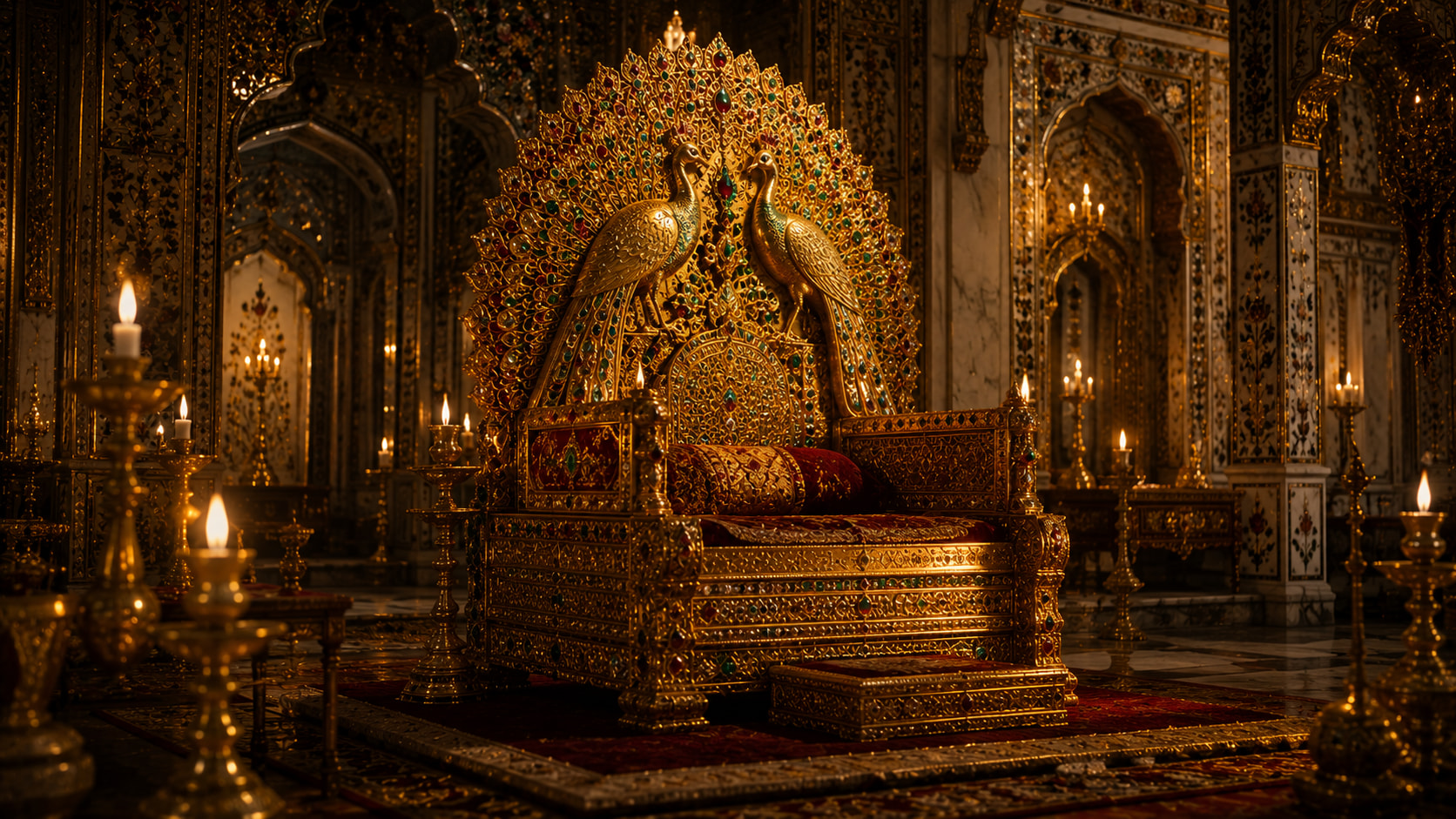
In the Hall of Private Audiences in the Red Fort of Delhi, the Mughal emperor sat upon a throne unlike any other ever built — a vast platform of solid gold, raised on jewelled legs, canopied above by two glittering peacocks whose spread tails were rendered in sapphires, emeralds, rubies, and pearls, and set among its gems were some of the most famous stones in history, including the diamond the world would come to know as the Koh-i-Noor. The Peacock Throne was the wealth of the richest empire on earth made solid, and it took seven years to build. And then, in 1739, a Persian army stormed into Delhi, butchered its people, emptied its treasury, and hauled the Peacock Throne away over the mountains to Persia — where, within a few short years, it vanished from history forever, broken up for the jewels that had made it the most precious thing in the world. This is the lost Peacock Throne.
The legend — the most precious throne ever made
The Peacock Throne is one of history’s great lost treasures, and one of the few whose loss can be dated almost to the year. It was the jewelled throne of the Mughal emperors of India, commissioned at the height of the empire’s golden age, and it became a byword for impossible wealth — a single object so laden with gold and famous gemstones that it may have been the most valuable thing ever made by human hands. Its story is a perfect arc of treasure and catastrophe: created as the crowning symbol of the world’s richest empire, looted in one of history’s most devastating sacks, and then lost and destroyed in the chaos that followed, its component jewels scattered to the four winds. Today no Peacock Throne survives — but its most famous stones glitter in the crown collections of the world, still carrying the argument over who they truly belong to. The throne is gone; the legend, and the jewels, remain.
Shah Jahan’s masterpiece
The throne was the creation of the Mughal emperor Shah Jahan — the same emperor who built the Taj Mahal — during what is considered the golden age of the Mughal Empire, when its rule covered almost the whole of the Indian subcontinent and its wealth was the envy of the world. Commissioned early in his reign and inaugurated in 1635, on the seventh anniversary of his accession (a date chosen by astrologers as doubly auspicious), the throne was installed in the Diwan-i-Khas, the Hall of Private Audiences in the Red Fort of Delhi, the ceremonial heart of the empire. It reportedly took some seven years to construct and, by tradition, cost even more than the Taj Mahal itself — a staggering investment of gold and gems that made it the ultimate expression of Mughal power and prestige. Upon it the emperor sat as the focus of the entire imperial order, the living center of the richest court on earth.
A throne of jewels
What made the throne legendary was its jewels. It was named for the two figures of peacocks displaying their tails that crowned it, rendered in a profusion of colored gemstones, and its structure of gold was encrusted with an extraordinary collection of the world’s greatest stones. Among the famous jewels associated with the Peacock Throne were the Koh-i-Noor and the Timur Ruby, along with other legendary stones — the Akbar Shah, the Great Mughal, the Great Table, and the Shah diamonds, and the Samarian spinel. These were not ordinary gems but some of the most storied jewels in the history of the world, gathered onto a single throne. The Peacock Throne was, in effect, a treasury made into furniture — the accumulated jewel-wealth of the Mughal dynasty mounted on gold and set under jewelled peacocks. It was this concentration of fabled stones that would make the throne both irresistible to a conqueror and, ultimately, the cause of its destruction.
What it looked like
We know the throne in detail because a European saw it and wrote it down. The French jeweller Jean-Baptiste Tavernier, permitted to examine the imperial treasures, left an awestruck description: a great rectangular seat raised on golden legs, its canopy supported by twelve emerald-covered pillars, hung with a fringe of pearls, and mounted above with the jewelled peacocks and a parrot said to be carved from a single emerald. Tavernier counted the stones by the hundred — enormous rubies and spinels, table-cut diamonds, and emeralds the size of walnuts — and reckoned the throne’s value at a sum so vast it strains belief even now, several times the cost of the Taj Mahal. The gold alone weighed a fortune; the gems were beyond price. It was less a chair than a monument, a solid cliff of gold and coloured fire on which a single man sat as the axis of an empire. No object before or since has concentrated so much of the world’s most precious material into one glittering whole — which is exactly why, when a conqueror came, it was the first thing he took.
Nadir Shah’s invasion
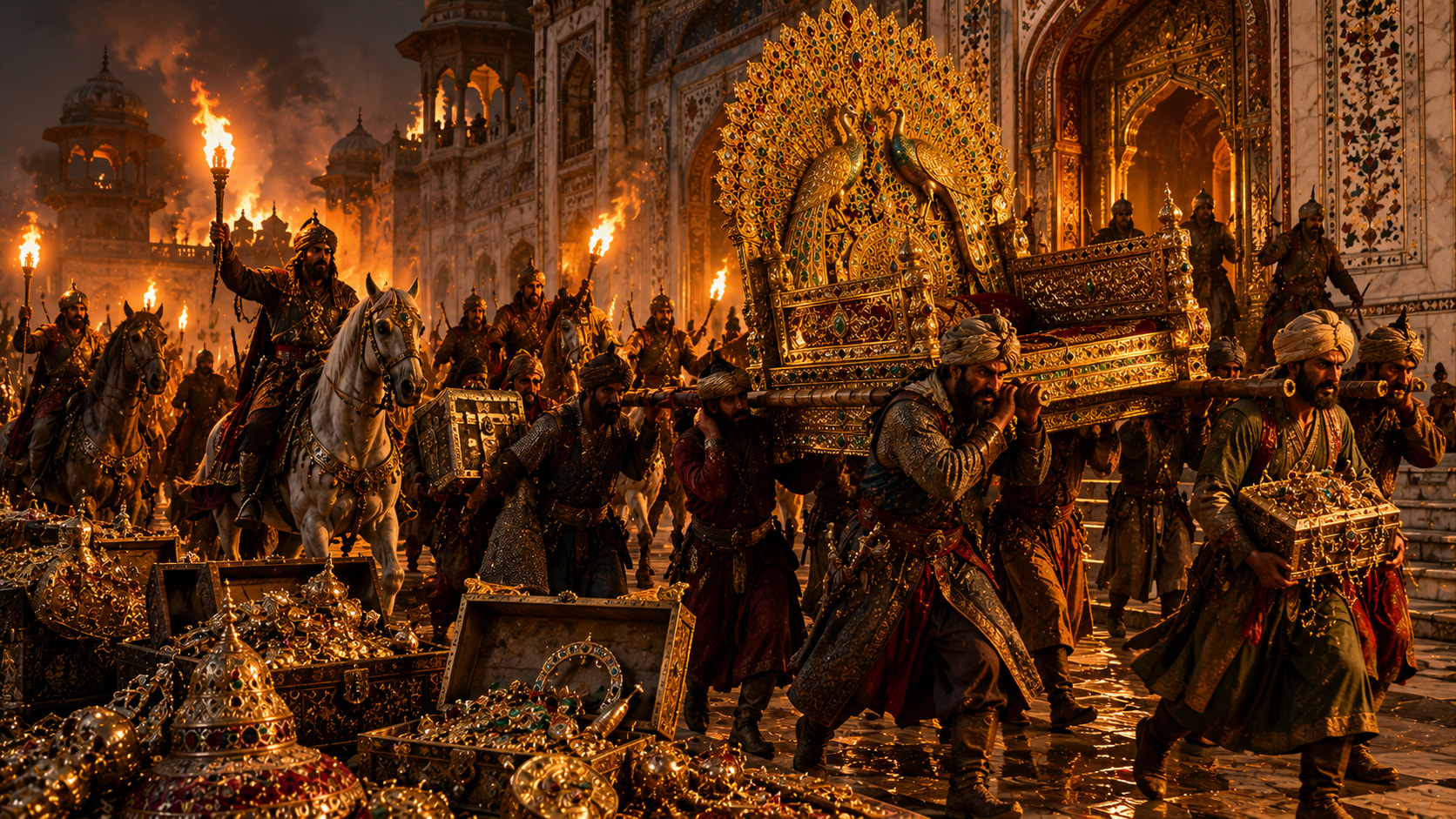
In 1739, catastrophe came from the northwest. Nader Shah, the formidable ruler of Persia, invaded the declining Mughal Empire, crushed the imperial army at the Battle of Karnal, and marched on Delhi. What followed was one of the most devastating sacks in Indian history: after violence erupted in the city, Nader Shah ordered a massacre, and his troops put much of Delhi to the sword while systematically stripping the Mughal capital of its wealth. The imperial treasury — the accumulated riches of generations of Mughal emperors — was emptied into Persian hands, and among the supreme prizes Nader Shah claimed was the Peacock Throne itself, taken as a war trophy and carried back toward Persia along with a mountain of other plunder. In a matter of weeks, the greatest treasure of the Mughal Empire passed out of India forever, borne away over the mountains by the conqueror who had broken Delhi.
The plunder that broke an empire
The scale of Nader Shah’s plunder is difficult to comprehend. He carried off not only the Peacock Throne but the jewels, gold, and accumulated treasure of the Mughal court on a scale so vast that it is said to have allowed him to exempt his own subjects in Persia from taxation for years afterward. The loot included the Koh-i-Noor and the Darya-i-Noor diamonds and a fortune in gems and bullion. For the Mughal Empire, already weakening, the blow was shattering: the loss of its treasury and its prestige accelerated the empire’s decline, and the sack of 1739 is often seen as a moment from which Mughal power never recovered. The Peacock Throne’s journey out of Delhi was thus not merely the theft of an object but the symbolic and material gutting of an empire — the richest court on earth stripped of the treasure that had been the foundation of its glory.
The turban trick
One of the most famous stories of the sack tells how Nader Shah got the greatest jewel of all. By the tale, the defeated Mughal emperor Muhammad Shah was rumored to keep the Koh-i-Noor hidden in the folds of his turban, never letting it out of his sight. Nader, learning the secret, proposed at a banquet that the two rulers exchange turbans as a gesture of eternal friendship — a courtesy the emperor could not refuse. Nader carried the turban to his tent, unwound it, and the great diamond tumbled out; and on seeing its blaze he is said to have cried “Koh-i-Noor!” — “Mountain of Light” — giving the stone the name it bears to this day. Whether the turban-swap happened exactly so, it captures the character of the plunder of Delhi: the wealth of the Mughals passing to Persia not only by force but by cunning, the richest empire on earth relieved of its greatest treasures in a single ruinous season. Nader rode home with the diamond, the throne, and a fortune that would have taken generations to amass — and almost none of it would bring him any peace.
The throne vanishes
And then, having survived for a century as the supreme treasure of two empires, the Peacock Throne simply disappeared. Nader Shah was assassinated by his own officers on 19 June 1747, and in the violent chaos that engulfed Persia after his death, the throne vanished — most probably dismantled or destroyed for its valuables, broken apart so that its gold could be melted and its priceless jewels pried loose and carried off by the men scrambling over the dead conqueror’s fortune. There was no grand final resting place, no tomb or vault — just a great treasure torn to pieces for its parts in the anarchy following an assassination. One persistent but unsubstantiated rumor held that the throne, or a throne, was given to the Ottoman Sultan — though this may have referred to a lesser throne produced later in Persia. The original Peacock Throne of Shah Jahan, the most precious object ever made, ceased to exist within eight years of leaving Delhi, and no trace of it intact has ever been found.
The scattered jewels
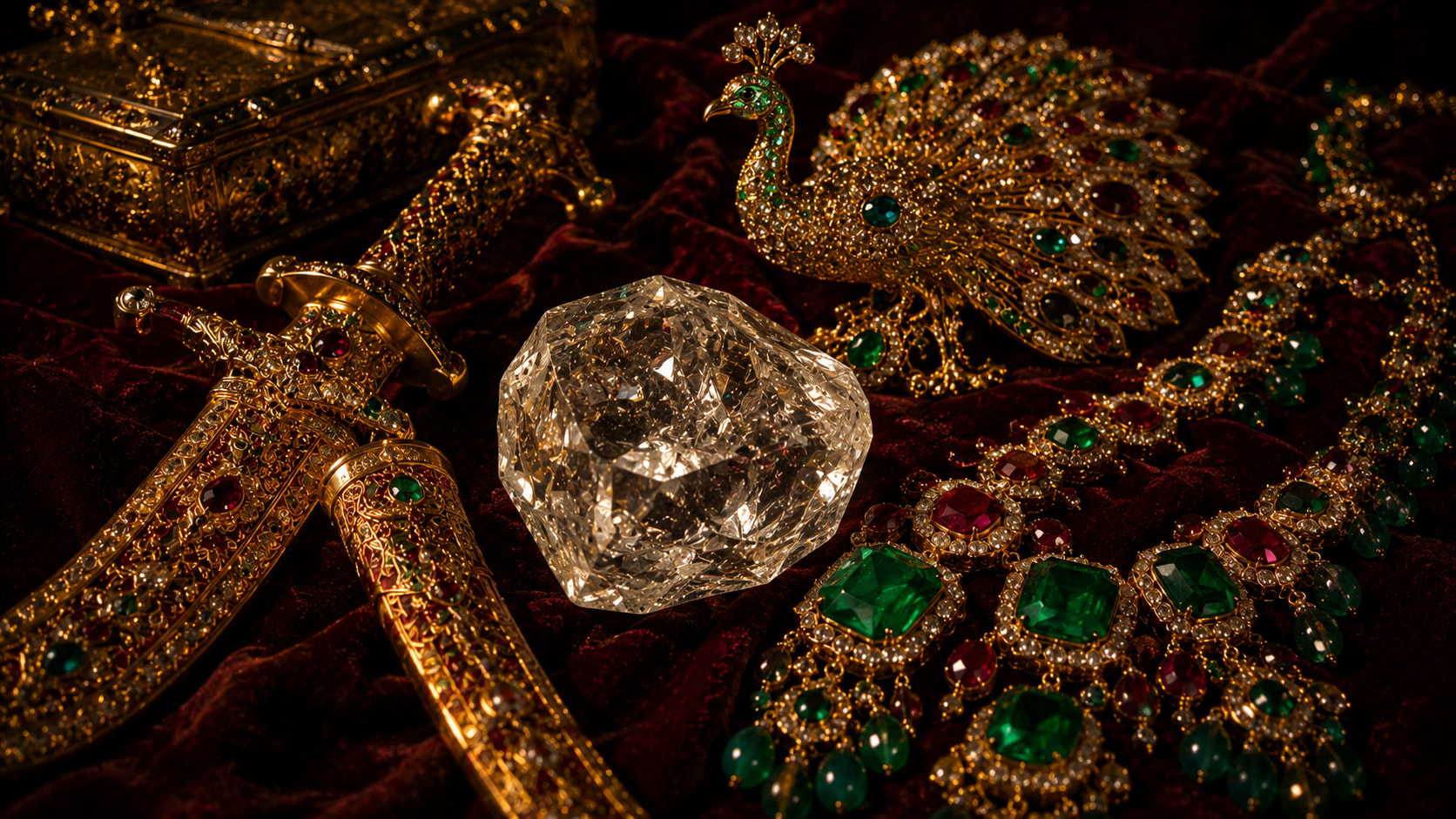
The throne was destroyed, but its jewels were far too valuable to vanish — and so they scattered across the world, each beginning a famous journey of its own. The most celebrated, the Koh-i-Noor (“Mountain of Light”), passed through Persian, Afghan, and Sikh hands over the following century — held by rulers including Ahmad Shah Durrani and later the Sikh maharaja Ranjit Singh — before being ceded to the British Crown in the mid-19th century, where it remains among the British Crown Jewels to this day, the subject of ongoing disputes over its rightful ownership. The Darya-i-Noor (“Sea of Light”) remained in Persia and is today part of the Iranian crown jewels. Other great stones from the throne and the Mughal treasury dispersed into royal collections and private hands across Persia, Afghanistan, India, and Europe. The Peacock Throne thus did not so much disappear as dissolve — its gold melted into anonymity, its legendary jewels scattered to the crowns and vaults of half the world, where some of them still blaze today.
The Koh-i-Noor’s long road
No fragment of the throne has travelled a stranger or bloodier road than the Koh-i-Noor. After Nader Shah’s murder it passed to his Afghan general Ahmad Shah Durrani, founder of the Afghan empire, and down through his troubled dynasty; then to the great Sikh ruler Ranjit Singh of the Punjab, who wore it on his arm and prized it above all he owned. When the British annexed the Punjab in 1849, the diamond was taken from the child-maharaja Duleep Singh and presented to Queen Victoria, recut in London into a smaller, brighter brilliant, and set into the British crown jewels, where it remains. Trailing it the whole way is an old and ominous saying — that whoever owns the Koh-i-Noor rules the world, but knows all its misfortunes — and a tradition that the stone brings ruin to any man who wears it, which is why, in British hands, it has been set only in the crowns of queens. From Mughal throne to Persian tent to Afghan treasury to Sikh armband to the Tower of London, the Mountain of Light has outlived every empire that possessed it — the most famous surviving splinter of the lost Peacock Throne.
The replacement thrones
The Mughals, though broken, did not vanish overnight, and later emperors used replacement thrones in the style of the lost original. But the curse of impermanence seemed to follow these too: a replacement Peacock Throne disappeared during or soon after the Indian Rebellion of 1857, the great uprising that ended the Mughal dynasty and brought India under direct British rule. With the fall of the last Mughal emperor, even the echoes of the great throne passed out of imperial use. The thrones that came after the original were never its equal — the first Peacock Throne had been a unique concentration of the Mughal golden age’s wealth, impossible to truly replace — but their losses too added to the sense that the Peacock Throne, in all its forms, was a treasure fated never to survive intact, slipping away again and again into the chaos of conquest and rebellion.
The jewels still in dispute
Because the throne’s stones survive, so does the argument over who owns them. The Koh-i-Noor, sitting in the Tower of London, is formally claimed by India, and pressed as well by Pakistan, Afghanistan, and Iran, each tracing a share of its bloody history through their lands — a diplomatic tangle the British Crown has never resolved. The Timur Ruby (in truth a great spinel), also taken from the Mughals, likewise rests in the British royal collection. The Darya-i-Noor remains a centrepiece of the Iranian crown jewels in Tehran. Each of these stones is a living relic of the vanished throne and of the plunder of 1739, and each carries an unhealed question of rightful ownership into the present day. The Peacock Throne, in this sense, has never really stopped being contested: three centuries after it was torn apart, the finest of its jewels are still fought over by nations, glittering in guarded vaults while governments and historians argue over the long trail of conquest that carried them there.
Where it stands today
No Peacock Throne exists today; the original was torn apart for its treasure nearly three centuries ago, and its replacements are gone as well. What survives is scattered and disputed: the Koh-i-Noor in the Tower of London among the British Crown Jewels, claimed by more than one nation as wrongfully taken; the Darya-i-Noor in Tehran; and other Mughal jewels in collections around the world, each a fragment of the lost throne’s glory. The Peacock Throne endures as one of the most evocative lost treasures in history — a symbol of the height of Mughal wealth, of the catastrophe of 1739, and of how even the most magnificent treasure ever made can be reduced, in a few short years of violence, to a handful of scattered stones and a legend. The throne of the Mughals was carried out of Delhi and never seen whole again. Its jewels are still out there, set in the crowns of the world — the last surviving pieces of the most precious thing that human hands ever built.
Related legends
The Padmanabhaswamy Temple Treasure (India) · The Amber Room · Croesus & the Lydian Gold (Karun Treasure) · The Legend of Solomon’s Mines · Treasure Legends (General) · India
Sources & further reading
- The Peacock Throne (Takht-i-Taus): commissioned by the Mughal emperor Shah Jahan, inaugurated 1635, installed in the Diwan-i-Khas of the Red Fort, Delhi; reputedly costlier than the Taj Mahal
- The throne’s jewels: the two jewelled peacocks, and famous stones including the Koh-i-Noor, the Timur Ruby, the Akbar Shah, Great Mughal, Great Table, and Shah diamonds, and the Samarian spinel
- Nader Shah’s invasion of India (1739): the Battle of Karnal, the sack and massacre of Delhi, the emptying of the Mughal treasury, and the seizure of the Peacock Throne as a war trophy
- The scale of the plunder and its role in the decline of the Mughal Empire
- The disappearance of the throne after Nader Shah’s assassination (19 June 1747) — most probably dismantled or destroyed for its valuables — and the unsubstantiated rumor of its gift to the Ottoman Sultan
- The scattering of the jewels: the Koh-i-Noor’s passage to the British Crown Jewels and the Darya-i-Noor in the Iranian crown jewels
- The later replacement thrones and the disappearance of a replacement during/after the Indian Rebellion of 1857
Weigh in
- The most precious object ever made, destroyed for its parts — what would you give to have seen it whole?
- Dismantled in Persia, or secretly preserved somewhere? How do you read the throne’s disappearance?
- The Koh-i-Noor sits in the Crown Jewels: who do you think it rightfully belongs to?
- Could any substantial piece of the original Peacock Throne still survive, unrecognized, today?
Reply below — bring your read on the plunder of Delhi, your theory on the throne’s fate, and your verdict on the scattered jewels. This is the lost Peacock Throne: the most opulent treasure ever crafted, broken apart in the chaos of conquest, its legendary stones scattered to the crowns of the world.