A Briny Deep field entry. A sword drawn from a stone, a round table where no man sits above another, a queen and the best knight in the world, a holy cup that draws the finest of them to glory and to ruin, and a king who did not die but sleeps, and will come again. The Arthurian legend is the great myth of Britain, built across a thousand years from a shadowy war-leader in a burning province into the most beloved king who never reigned. This room follows the whole golden accretion: the first names in the old Welsh songs, the book that raised the king, the French poets who gave him the Grail, and the isle where he waits still.
No legend in the Western world has been loved longer or passed through more hands than the story of King Arthur. He is the heart of the Matter of Britain — the vast medieval cycle of Camelot and the Round Table, of Merlin and Morgan, of Lancelot and Guinevere, and of the doomed and shining quest for the Holy Grail. And he is a wonder of a different kind, because the Arthur we love was not written by any single age but built up, generation upon generation, each adding a sword, a knight, a betrayal, a miracle, until the figure blazing at the centre had become the mirror in which the whole West saw its dream of the good king. This room gathers that long building-up, from the first faint war-cry in a Dark Age poem to the sleeping monarch who will ride out again in Britain’s darkest hour.

The Matter of Britain
“The Matter of Britain” is the medieval name for the whole body of story gathered around Arthur and his court — one of the three great cycles of European romance, standing beside the Matter of France, which sang of Charlemagne, and the Matter of Rome, which sang of antiquity. In the oldest tradition, Arthur appears as a war-leader of the post-Roman Britons, holding the island against the invading Anglo-Saxons in the desperate years of the late fifth and early sixth centuries, when Rome had withdrawn its legions and the light of the old order was going out across Britain. From that seed — a Christian champion in a darkening land — grew Camelot and the Round Table, Merlin and the enchanted sword, the fellowship of the finest knights alive, and the quest that would define and destroy them: a literature vast enough to fill libraries, all of it flowering from a few fierce lines in the oldest books of Wales.
The war-cry in the old songs
The first traces of Arthur are the most stirring, because they come as fragments out of the dark. The Welsh heroic poem Y Gododdin, whose roots may reach back to around 600 AD, praises a warrior of terrible prowess and then adds the highest measure of all — that mighty as he was, “he was no Arthur.” The name was already a byword for greatness. Around 830 the monk Nennius, in his Historia Brittonum, names Arthur outright as the dux bellorum, the “leader of battles,” and lists his twelve victories over the Saxons, culminating at Mount Badon, where, the chronicler writes, Arthur charged with the image of the Virgin on his shield and nine hundred and sixty of the enemy fell before him alone. The Annales Cambriae, the old Welsh Annals, set down two dates that ring like a bell: Badon, where Arthur bore the cross of Christ for three days and three nights; and, some twenty years later, the fatal field of Camlann, “in which Arthur and Medraut fell.” From these few burning lines the whole later blaze was kindled.
The book that raised the king
The legend as the world knows it begins with one magnificent book. Around 1136, Geoffrey of Monmouth completed his Historia Regum Britanniae — the History of the Kings of Britain — a sweeping chronicle that made Arthur a conqueror to rival Caesar and handed the legend nearly all its furniture at a stroke. Here first appear Arthur’s father Uther Pendragon; the enchanter Merlin, who by his arts brings about Arthur’s conception at Tintagel upon Igerna, wife of Gorlois of Cornwall; the queen Guinevere; the great sword Caliburn, forged in Avalon; Arthur’s continental empire and his war against Rome; the treachery of his nephew Mordred; the last dreadful battle; and the wounded king’s passing across the water to the isle of Avalon to be healed. Geoffrey claimed to be translating “a very ancient book in the British tongue,” and whether that book was real or a marvel of his own making, his Historia became the sensation of the age and carried Arthur into the imagination of all Europe.
The prophet Merlin
Chief of Geoffrey’s gifts to the legend was Merlin — Myrddin of the older Welsh tradition, the fatherless boy whose prophecies Geoffrey set down in a book of their own, the Prophecies of Merlin, that was copied and pored over for centuries. In Geoffrey’s telling it is Merlin who, by his art, transports the great stones of the Giants’ Dance from Ireland to Salisbury Plain to raise a monument to the dead — the legend’s own explanation for Stonehenge — and Merlin who shifts Uther’s very shape to win Igerna and set Arthur’s birth in motion. Prophet, shape-changer, engineer of destiny, half-wild seer of the woods in Geoffrey’s later Vita Merlini, Merlin became the pattern of every wizard the West has imagined since. He stands at the beginning of Arthur’s story as the hand that arranges fate, and he vanishes from it — trapped, the romances say, by an enchantment of his own teaching — before the end.
The Round Table and the sword
What Geoffrey began, the poets swiftly enlarged. The Norman writer Wace, translating Geoffrey around 1155, added an image that would become the legend’s beating heart: the Round Table, built so that no knight should sit above another, every man at the board an equal in honour. And the legend’s two great swords took shape. There is the sword in the stone, set fast in an anvil in a London churchyard with the writing that whoever drew it was the true-born King of all Britain — and the boy Arthur, sent to fetch a blade for his foster-brother, draws it without knowing what he does, and is crowned. And there is Excalibur itself, given to him by the Lady of the Lake, an arm rising robed in white samite from the water to hold it out; its scabbard, said the wise, was worth ten of the sword, for while he wore it the king could lose no blood. At the very end, the dying Arthur commands Sir Bedivere to cast Excalibur back into the mere, and the hand rises once more from the water to catch it and draw it under.
Camelot and the fellowship
Around the king gathered the most glorious company in all of story. His court was Camelot, the shining city; his fellowship the knights of the Round Table, and their names are a litany — Gawain the sun-strong and courteous; Kay the seneschal and Bedivere the faithful; Percival the holy fool; Bors and Tristan and, greatest of all in arms, Sir Lancelot du Lac, raised by the Lady of the Lake and unmatched by any living knight. The romances that the French poet Chrétien de Troyes perfected in the late twelfth century turned the legend inward, from the clash of armies to the inner life of the knight: courtly love, the sworn quest, the trial of honour, the lady’s favour worn into battle. Camelot became the very image of the good and gracious kingdom, the brief noon of the world when justice reigned and the strong protected the weak — and, because it was so bright, its fall would be the more terrible.
The Grail
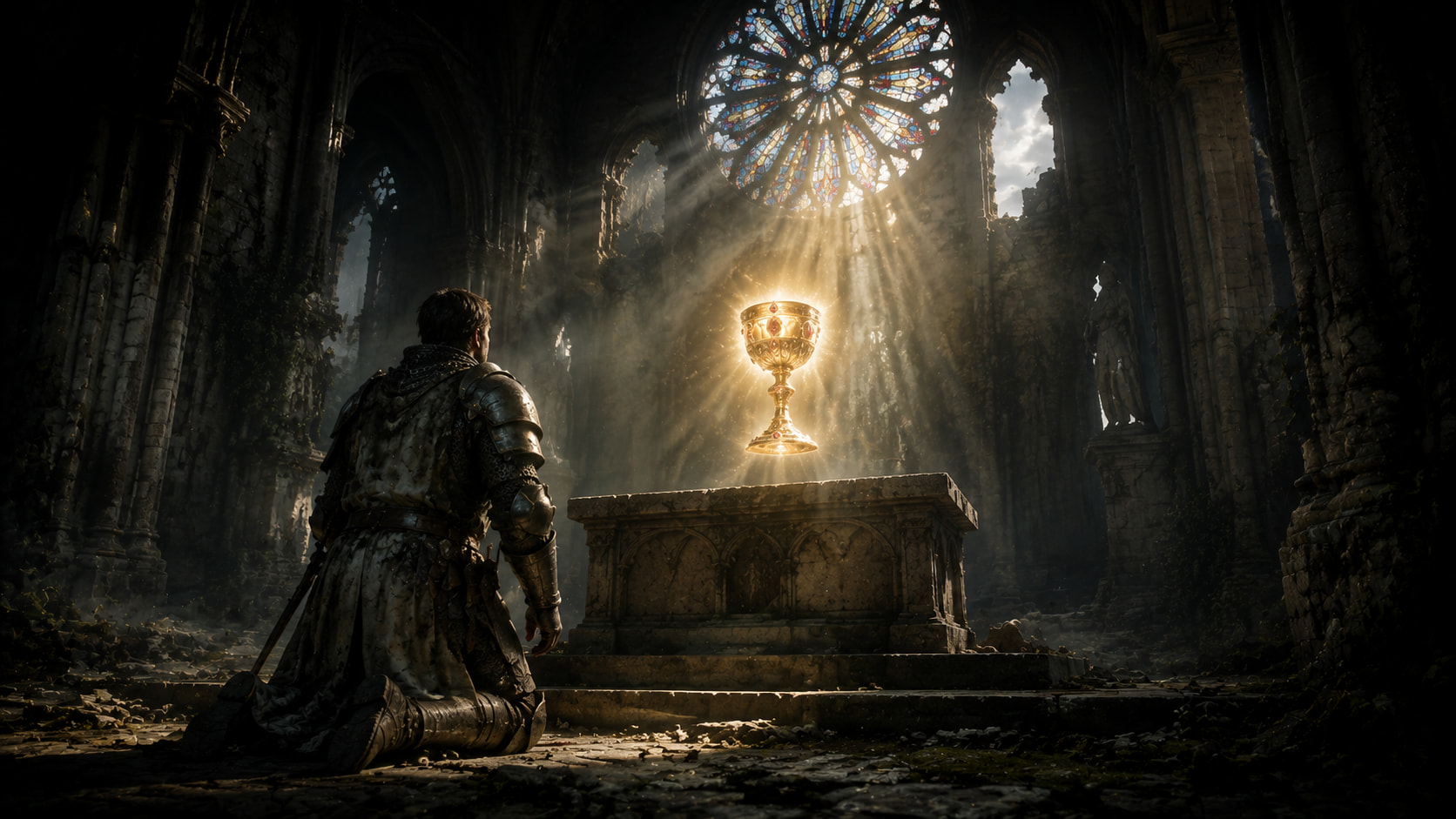
Into that world Chrétien introduced the mystery that would become the legend’s soul. In his unfinished Perceval, the Story of the Grail, a young knight comes to a strange castle and sees a procession pass — a bleeding lance, and then a graal, a precious vessel that gives off a holy light — and, schooled to be silent, fails to ask the question that would have healed the wounded Fisher King and the waste land with him. Later poets unveiled what the vessel was. Robert de Boron made the Holy Grail the very cup of the Last Supper, in which Joseph of Arimathea caught the blood of the crucified Christ and which he bore in time to Britain; Wolfram von Eschenbach, in his Parzival, made it a stone fallen from heaven. In the great prose cycles the quest became the summit of the whole legend: only the perfectly pure knight — Galahad, Lancelot’s son — could achieve the Grail and be taken up in its light. And the quest that ennobled the Round Table also emptied it, drawing the best knights out from Camelot into the wilderness, so that the fellowship never gathered whole again.
The love that broke the world
For all its glory, Camelot carried the seed of its own ruin, and the legend never flinched from it. The queen Guinevere and Lancelot, the king’s dearest knight, fell into a love neither could master, and when it was at last dragged into the light the fellowship split against itself. War broke out; Arthur was drawn overseas; and in his absence his nephew Mordred seized the crown and the queen both. The king returned to a final, catastrophic battle at Camlann, where father and traitor-son dealt each other their death-wounds and the flower of the Round Table fell around them in the mist. So the bright kingdom went down in blood and sorrow — not destroyed from outside by any enemy, but broken from within by love and pride, which is why the story has never stopped feeling true.
The whole book
The scattered tales were gathered into the form the English-speaking world best knows by Sir Thomas Malory, an English knight who compiled the great French and English romances into a single mighty work while himself a prisoner, finishing it around 1469. Printed by William Caxton in 1485 on England’s young press, Le Morte d’Arthur fixed the canonical shape of the whole legend — the sword in the stone, the Lady of the Lake, the founding of the Round Table, the coming of Lancelot, the Grail quest, the love of Lancelot and Guinevere, and the long, sorrowful fall of Camelot — in prose of such grave beauty that it has never been bettered. Nearly every Arthur since, in poem and novel and film, from Tennyson’s Idylls to the screen, descends from Malory’s telling. He gave the king his most famous words, carved (the book says) upon his tomb: Here lies Arthur, the once and future king.
Avalon and the sleeping king
For Arthur, alone among the heroes of the West, was not allowed to simply die. Geoffrey had sent the mortally wounded king across the water to Avalon, the isle of apples, to be healed of his wounds by Morgan and her sisters — borne away on a black barge full of weeping queens. And out of that passing grew the legend’s most haunting promise: that Arthur is not dead but sleeping, and will return when Britain’s need is greatest. The Bretons and the Welsh held it so fiercely in the Middle Ages that to deny it could start a brawl. All across the island the folk-tale fixed him beneath the earth — asleep with his knights in a hidden cave under a hill, their horses saddled, waiting for the horn that will wake them. He is the Rex quondam Rexque futurus, the once and future king, the hero who has not finished with the world. No other legend ends on so unbearable and so hopeful a note: not he was, but he will come again.
Glastonbury and the tomb
And there is one place where the legend touched the solid earth. Glastonbury in Somerset, its great Tor rising like an island above the flooded levels, was held to be Avalon itself, the isle of apples where Arthur was carried. Older still was the tale that Joseph of Arimathea had come there in the first age of the faith, thrusting his staff into Wearyall Hill, where it took root and blossomed as the Glastonbury Thorn that flowers at Christmas, and bringing with him the Grail, whose presence is remembered in the blood-red waters of the Chalice Well. Then, in 1191, the monks of Glastonbury Abbey, digging in their old cemetery, came upon a great hollowed log far down in the earth, and with it a lead cross graven in ancient letters: Here lies buried the renowned King Arthur in the isle of Avalon. Within lay the bones of a mighty man, his skull scarred with wounds, and beside him a woman with a tress of golden hair. King and queen were reburied before the high altar, and in 1278 laid again in a black marble tomb in the presence of King Edward I — a shrine that stood until the abbey fell, and whose empty site the pilgrim can stand beside to this day.
The treasure-hunter’s angle
The Arthurian world holds the most exalted treasure-quest of them all — the Holy Grail, the supreme unfound object, sought for nine centuries and never claimed, the very pattern of every grail-shaped hunt since. And it is chased in the solid world as well as on the page: Welsh tradition keeps the Nanteos Cup, a worn old wooden mazer long revered as the Grail and famed for healing; Glastonbury guards its Thorn and its well; and relic-hunters follow Joseph of Arimathea’s trail across the West Country. Beside the Grail stand Excalibur, returned to the waters and never recovered, and Avalon, the hidden isle where the king lies sleeping. And seekers have hunted Camelot in the earth itself — fixing above all on South Cadbury in Somerset, the great hillfort that the antiquary John Leland reported the local people called “Camalat,” and where twentieth-century excavation uncovered a Dark Age stronghold refortified with a mighty hall in exactly Arthur’s age. From Tintagel on its Cornish cliff to the round table that hangs in Winchester’s ancient hall, the legend has left a map across Britain. Whether the prize is a cup, a sword, a city, or a sleeping king, the Arthurian legend gave the treasure hunt its highest and noblest form: the search that makes the seeker worthy, whether or not it ever ends.
Related rooms
The Dark Ages · The Druids · Norse Mythology · Mythological Creatures · The Holy Grail · United Kingdom
Sources & further reading
- King Arthur as the heart of the “Matter of Britain,” portrayed in the earliest tradition as a post-Roman war-leader against the Anglo-Saxons of the late 5th–early 6th centuries
- The earliest sources: the Welsh poem Y Gododdin (“he was no Arthur”); Nennius’s Historia Brittonum (c. 830), Arthur as dux bellorum and the twelve battles ending at Mount Badon; and the Annales Cambriae (Badon and the fall at Camlann)
- Geoffrey of Monmouth’s Historia Regum Britanniae (c. 1136): Uther Pendragon, Merlin, the conception at Tintagel, Guinevere, the sword Caliburn, Mordred, Camlann, and Avalon; the Prophecies of Merlin and Vita Merlini, and Merlin’s raising of the Giants’ Dance (Stonehenge)
- Wace’s Roman de Brut (c. 1155) and the Round Table; the swords of the legend (the sword in the stone and Excalibur of the Lady of the Lake)
- Chrétien de Troyes (late 12th c.): Lancelot, Camelot, courtly romance, and Perceval, the Story of the Grail; Robert de Boron’s Grail as the Last Supper cup of Joseph of Arimathea; Wolfram von Eschenbach’s Parzival (the Grail as a stone); Galahad and the prose Grail cycles
- Sir Thomas Malory’s Le Morte d’Arthur (c. 1469; printed by William Caxton, 1485) and the “once and future king”
- Avalon and the sleeping-king (Breton hope) legend; Glastonbury as Avalon, Joseph of Arimathea and the Glastonbury Thorn and Chalice Well, the 1191 discovery of the tomb and its lead cross, and the 1278 reburial before Edward I
- The Camelot candidates and relics: South Cadbury (John Leland’s “Camalat” and the later excavations), Tintagel, the Nanteos Cup, and the Winchester Round Table
Weigh in
- Does it matter to you whether a flesh-and-blood Arthur ever lived — or is the legend the greater for being a legend?
- The Grail quest ennobled the Round Table and also emptied it — what do you make of a treasure that both perfects and destroys the fellowship that seeks it?
- Camelot fell not to an enemy but to love and pride from within — why does that ending feel so true?
- Which teller shaped your Arthur most: Nennius’s war-leader, Geoffrey’s emperor, Chrétien’s Grail-knights, or Malory’s whole sorrowful book?
- “Not dead but sleeping, and will come again” — why has the once-and-future king held that promise over the West for a thousand years?
Reply below. Bring your kings and your knights, your Grail lore and your Camelot theories, your Glastonbury pilgrimages and your sleeping-king tales — this room is built to weigh them all.