A Briny Deep field entry. The earth keeps giving them back. Whole cities — whole peoples — fell into ruin, were swallowed by jungle, sand, ash, or sea, and were forgotten so completely that the world forgot they had ever been. Then a farmer’s spade, a traveller’s rumor, a diver’s lamp, or a satellite’s eye brought them up again. This room is the roll of the recovered and the still-missing: the frozen city under the volcano, the temple older than farming, the drowned ports off a dozen coasts, the cities the desert and the jungle are only now surrendering — and the long human dream of the sunken continent. Wonder first, and here the wonder keeps coming true.
Of all the mysteries in this wing, this is the one that keeps proving itself. A lost civilization is exactly what it sounds like — a people and their cities that declined, emptied, and were so thoroughly forgotten that their very existence dropped out of the world’s memory. And then, over and over, they have been found: under ash and lava, under drifting sand, under jungle canopy, beneath the streets of later towns, at the bottom of the sea. The centuries-long hunt for these vanished worlds did more than thrill the age of explorers — it gave birth to the science of archaeology itself, and it has not slowed. In this generation alone the earth has handed back a temple six thousand years older than Stonehenge and whole cities the maps never carried. This room gathers the great rediscoveries, the deepest of them all, the drowned and the sand-swallowed and the jungle-lost, and the oldest dream of all — the continent beneath the waves.
The city that stopped breathing
No lost city speaks like the one the fire kept. When Vesuvius erupted on an August afternoon in 79 AD, it buried the Roman towns of Pompeii and Herculaneum under twenty feet of ash and superheated mud, sealing a single ordinary day forever. Rediscovered by well-diggers in the eighteenth century — Herculaneum in 1738, Pompeii in 1748 — they came up not as ruins but as a paused world: loaves of bread still in the ovens, election slogans and tavern graffiti still on the walls, a dog still straining at its chain. The archaeologist Giuseppe Fiorelli later poured plaster into the hollows the decayed bodies had left in the hardened ash, and up came the casts of the dying in their last postures — a mother shielding a child, a man with his hand to his face. Pompeii is the closest the earth has ever let us come to walking into the past and finding it still warm.
The city the poet remembered
For twenty-five centuries Troy was thought to live only in Homer. Then a German merchant turned obsessive, Heinrich Schliemann, took the Iliad as a treasure map, drove his trenches into a Turkish mound called Hisarlik in the 1870s, and struck city walls — not one Troy but nine, stacked ruin on ruin across four thousand years. In 1873 he unearthed a cache of gold diadems, cups, and jewels he proclaimed the “Treasure of Priam,” draping his wife Sophia in the earrings of a Bronze Age queen for the photograph that stunned Europe. His methods were a bull’s rush and his identifications half wrong, but the essential thing was true: there had been a real city where the poem said, burned and rebuilt and burned again. The line between legend and dirt had been crossed, and archaeology has never entirely recovered its nerve about where else that line might lie.
Rediscoverers on every continent
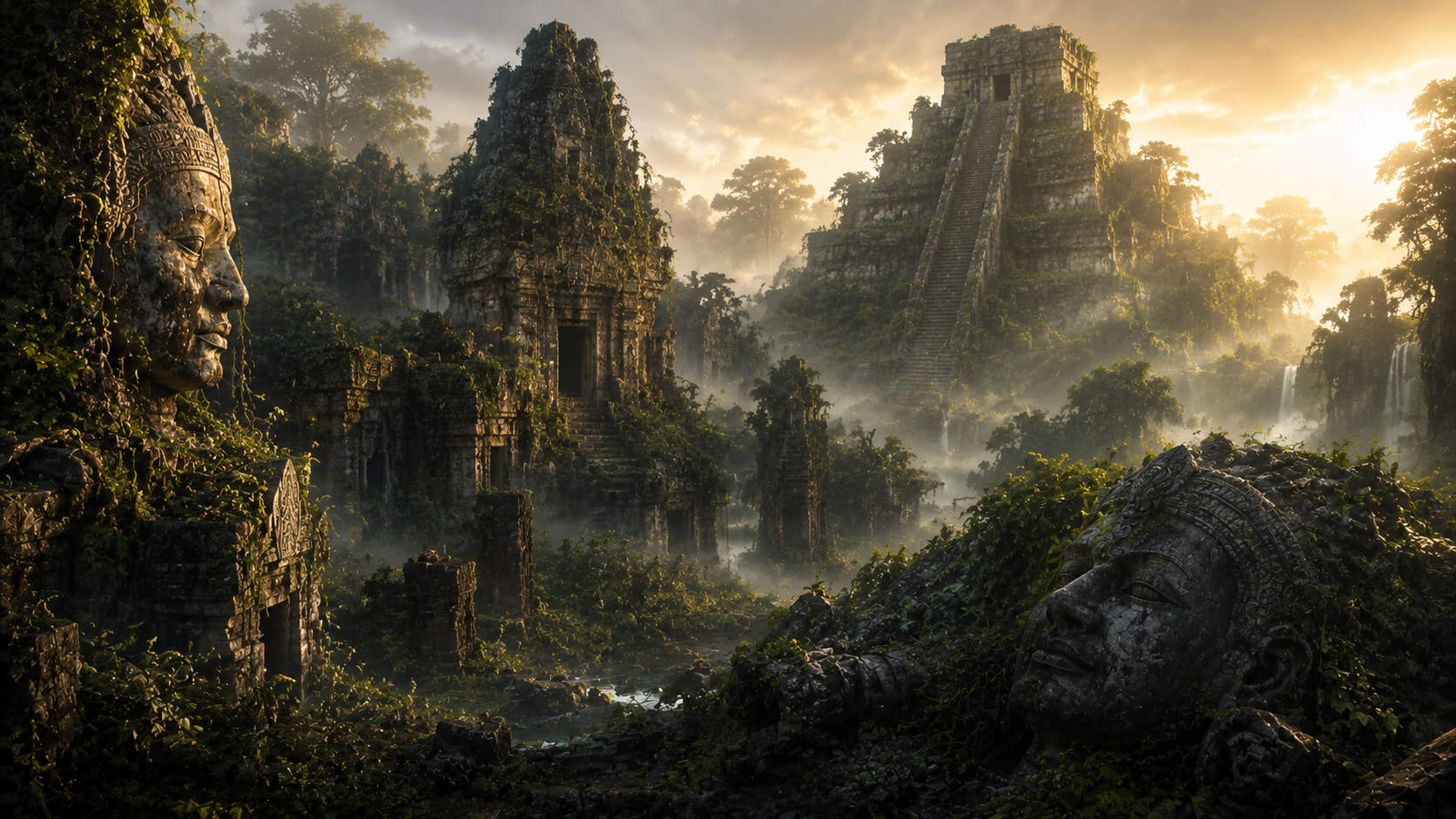
The nineteenth century became a great age of finding, and the roll of recovered wonders reads like an atlas of astonishment. In the deserts of Mesopotamia, Austen Henry Layard dug the palaces of Nineveh and Nimrud from their mounds in the 1840s and lifted out the winged bulls of Assyria and, greatest of prizes, the library of Ashurbanipal — cuneiform tablets that gave the world back the Epic of Gilgamesh. In 1812 the Swiss traveller Johann Ludwig Burckhardt, disguised and alone, talked his way through a slot canyon in Jordan and became the first Westerner in centuries to stand before Petra, the rose-red Nabataean city carved into living rock. In 1839 the American John Lloyd Stephens and the artist Frederick Catherwood hacked through Central American jungle to Copán and Palenque and revealed the ruined glory of the Maya to a disbelieving world. A French naturalist’s account carried the temple-mountains of Angkor, heart of the Khmer Empire, to European wonder. And in 1911 the explorer Hiram Bingham, led by a local boy up a Peruvian ridge, stepped into the cloud-wrapped Inca citadel of Machu Picchu. Each had stood there all along — waiting, as the lore has it, for someone to come looking.
The civilization nobody remembered
Some vanished worlds were not single cities but whole civilizations erased from the ledger of history. In the 1920s, excavations at Mohenjo-daro in Sindh and Harappa in the Punjab uncovered the Indus Valley Civilization — a Bronze Age society contemporary with the pyramids, spread across a territory larger than Egypt and Mesopotamia combined, that no one had known existed. Its people built cities on a grid, with standardized fired brick, covered street drains, public wells, and the great watertight tank at Mohenjo-daro called the Great Bath; they traded with Sumer, weighed goods with a precise cubic system, and stamped soapstone seals with humped bulls and a script of neat little signs. That script has never been deciphered — we can walk their streets but cannot read a word they wrote — and their cities were abandoned around 1900 BC for reasons still argued. An entire literate civilization of a million souls fell out of memory so completely that history rediscovered it only a century ago.
Kings the ground denied
In southern Africa the stone testified against the prejudice of those who found it. Great Zimbabwe — mortarless granite walls up to thirty-six feet high, a soaring conical tower, an enclosure that curves for hundreds of feet — was raised between the eleventh and fifteenth centuries by the ancestors of the Shona, the capital of a gold-trading kingdom whose soapstone bird carvings became a nation’s emblem. Colonial-era treasure-seekers who could not bear to credit Africans with such grandeur invented Phoenicians and Queens of Sheba to explain it away, even as they looted its artifacts; the archaeology, patiently and completely, gave the city back to its true builders. Across the ocean the same lesson waited at Cahokia, near modern St. Louis, where a Mississippian people raised a hundred earthen pyramids around a plaza, topped by the ten-story Monks Mound, and a city of perhaps twenty thousand — the largest north of Mexico — flourished around 1100 AD and then dispersed, leaving mounds that later settlers mistook for hills.
The temple before the town
The most astonishing rediscovery of all is also the oldest. At Göbekli Tepe in southeastern Turkey, the archaeologist Klaus Schmidt began in 1995 to uncover rings of monumental T-shaped limestone pillars, some sixteen feet tall and sixteen tons, carved in relief with foxes, vultures, boars, scorpions, and snakes — and dated them to around 9500 BC. That is before writing, before metal, before pottery, before the wheel, and, most staggering of all, before farming — six thousand years older than Stonehenge, raised by people we had filed away as simple hunter-gatherers. Then, after centuries of use, its builders deliberately buried it. Göbekli Tepe overturned the settled story of how civilization began: the temple, it appears, may have come before the town, the gathering to worship pulling people into the first settled life rather than the other way round. Nearby, at Karahan Tepe and a dozen other mounds of the Taş Tepeler, the same lost world is still emerging. The earth had been keeping the single deepest secret about our own origins, and gave it back only in living memory.
The drowned world
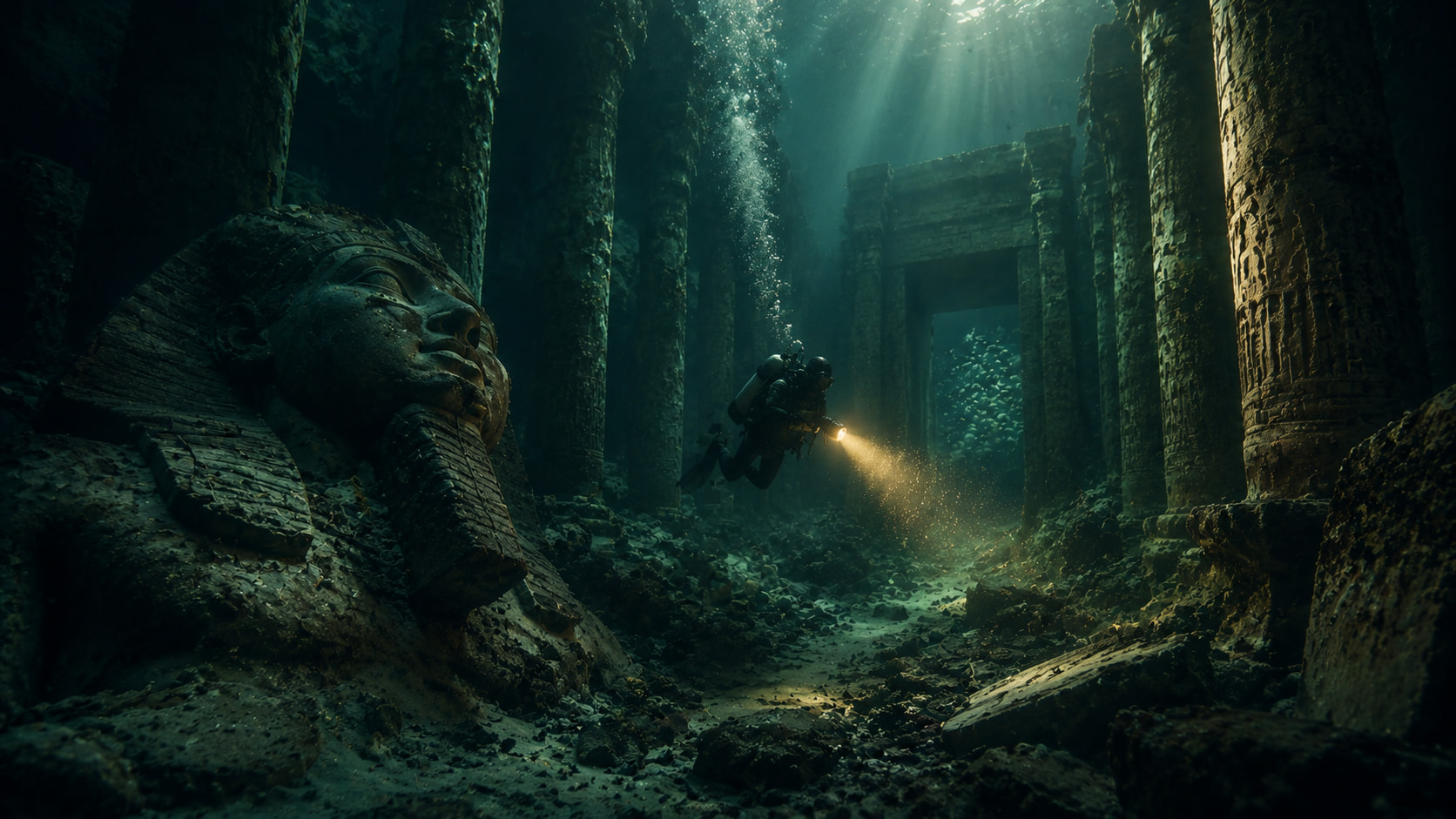
The sea keeps its own cities, and diving archaeology has begun to raise them. Off the Egyptian coast in 2000, the underwater explorer Franck Goddio found Thonis-Heracleion, the great port at the mouth of the Nile through which Egypt once met the Greek world — colossal statues, temple stones, and a hundred ancient ships lying under the silt of Aboukir Bay, a whole city that had slid beneath the sea. In Greece lies Pavlopetri, a Bronze Age town with streets and courtyards still traceable on the seabed, and off the coast of India, marine surveys near Dwarka have found stone structures in the shallows that tradition ties to the legendary city of Krishna. Jamaica keeps the pirate capital of Port Royal, the “wickedest city on earth,” which an earthquake dropped into the harbor in a single morning in 1692 and preserved with its taverns and its stopped pocket-watches. And in the Bay of Naples, Roman Baiae — the pleasure-resort of emperors — lies in the shallows of a marine park, its mosaic floors and marble columns swum over by tourists where senators once bathed. The map runs out at the waterline, and beneath it the lost cities are still standing.
The sand keeps its own
Where the sea drowns cities, the desert buries them, and its lost worlds are surfacing too. In 1992 a team led by the filmmaker Nicholas Clapp used satellite radar to trace ancient caravan tracks converging on a single point in the empty sands of southern Oman — and dug up the frankincense-trading fortress that local legend, and the Qur’an, remembered as Ubar, the fabled “Iram of the Pillars,” swallowed (the stories say) when the earth opened beneath its collapsing limestone cavern. Across the Sahara, the Roman colonial city of Timgad in Algeria — a perfect grid laid out for legion veterans in 100 AD, with its arch, its theater, its library — was so completely covered by dune-sand after the Arab conquest that it slept intact for a thousand years until French excavators swept it clean, the “Pompeii of Africa.” And along the old Silk Road, the archaeologist-explorer Aurel Stein walked the deadly Taklamakan in the early 1900s and pulled whole oasis kingdoms — Loulan, Niya, Dandan Oilik — from beneath the drifting dunes, their timber houses, painted panels, and even the tall, uncannily preserved Tarim mummies left exactly as the desert had taken them. The sand is a patient archive, and it is beginning to open.
The jungle gives them up
The newest age of discovery flies. Lidar — laser pulses fired from aircraft that strip away the forest canopy and map the ground beneath — has, in barely a decade, rewritten the map of the Americas. A 2018 aerial survey over the Guatemalan Petén revealed more than sixty thousand previously unknown Maya structures under the trees — causeways, fortresses, pyramids, and terraced farms feeding a population far larger than anyone had dreamed, all radiating from lost giants like the vast El Mirador. In the Bolivian Amazon, lidar has uncovered the Casarabe cities — Cotoca and Landívar, ringed by moats and causeways, the first true urbanism ever proven in the rainforest. In Ecuador’s Upano Valley, laser mapping found a network of ancient garden-cities two thousand years old. And in the mountains of Honduran Mosquitia, a lidar survey chasing the old legend of the White City — Ciudad Blanca, the City of the Monkey God — found a real, unlooted ruin exactly where the stories placed it, and an expedition in 2015 walked in to a cache of stone offerings no hand had touched in five centuries. The jungle is surrendering its dead cities faster than scholars can name them.
The continent beneath the waves
Older than any of these recoveries is the dream that pulls them: the belief in a great sunken land that carried a lost golden age down with it. The most famous is Atlantis, Plato’s island empire beyond the Pillars of Heracles, drowned in a day and a night — a legend so vast it holds its own room in this wing. But it has company. In 1864 the zoologist Philip Sclater, puzzling over lemur bones found on opposite shores of the Indian Ocean, proposed a vanished land-bridge continent he named Lemuria; the idea escaped science and bloomed into a whole mystical geography of a drowned homeland of humanity. The traveller-writer Augustus Le Plongeon and, after him, James Churchward in his popular volumes of the 1920s and '30s raised the lost continent of Mu — a Pacific motherland of fifty thousand years past, its refugees the seed, they held, of every later civilization from Egypt to the Maya. From the frozen paradise of Hyperborea to the sunken cities of a hundred flood-myths, the drowned homeland is one of the deepest and most enduring stories our species tells — the memory, or the hope, of a greatness the waters took.
Why a world falls
Read the roll and the ways of dying repeat. Fire took Pompeii in an afternoon; an earthquake dropped Port Royal between one breath and the next; the slow retreat of the rains emptied the Maya heartland and, some hold, dried the rivers that fed the Indus; a shifting coastline drowned Thonis-Heracleion; conquest and the turning of trade routes starved Petra and the Silk Road towns until the sand moved in. But what truly unites them is not catastrophe alone — it is forgetting. The last survivors scatter, the roads go quiet, the name passes out of speech in a generation or two, and a place that once held a hundred thousand lives becomes a hill that farmers plow around without a second thought. That is the humbling lesson of this room: a civilization does not need to be destroyed to be lost. It only needs to be left, and given time.
The treasure-hunter’s angle
No room in this wing sits closer to the treasure hunter’s heart, because here the treasure is literal, and it keeps coming up. From the lost cities have risen some of the greatest hoards ever recovered: the gold of the Royal Tombs of Ur, where Leonard Woolley in the 1920s lifted the headdress and jewels of Queen Puabi, the Standard of Ur, and the golden Ram in a Thicket from a death-pit forty-five centuries deep; the death-mask of Tutankhamun, found by Howard Carter in 1922 behind a sealed door in the Valley of the Kings, eleven kilograms of worked gold that had waited three thousand years; the tomb of the Lord of Sipán in Peru, opened by Walter Alva in 1987, a Moche warrior-priest buried in gold and turquoise; and the astonishing bronze masks and gold of Sanxingdui in China, pits of a lost Shu kingdom that no text had ever named, still being excavated today. And the work is nowhere near finished — the lidar is still mapping, the divers are still descending, the undeciphered scripts still guard their words. The lost civilization is the supreme treasure hunt: the one where the prize is not a chest but an entire forgotten world, and where the earth, generation after generation, keeps handing them back.
Related rooms
Atlantis · The Antediluvian World · Ancient Aliens · The Dark Ages · The Srivijaya Empire
Sources & further reading
- How the search for lost cities gave rise to archaeology; Pompeii and Herculaneum (buried 79 AD; unearthed 1738 and 1748) and Fiorelli’s body-casts
- Troy: Heinrich Schliemann at Hisarlik in the 1870s and the “Treasure of Priam” (1873); the nine cities of the mound
- The great rediscoverers: Layard at Nineveh and Nimrud and the library of Ashurbanipal; Burckhardt at Petra (1812); Stephens and Catherwood in the Maya lands (1839–41); Angkor and the Khmer Empire; Hiram Bingham at Machu Picchu (1911)
- The Indus Valley Civilization at Mohenjo-daro and Harappa (excavated from the 1920s), its planned cities, Great Bath, and still-undeciphered script; Great Zimbabwe (11th–15th centuries) and Cahokia with Monks Mound
- Göbekli Tepe (Klaus Schmidt, from 1995), ~9500 BC, predating farming, pottery, and metal; Karahan Tepe and the Taş Tepeler
- The drowned cities: Thonis-Heracleion (Franck Goddio, 2000), Pavlopetri, Dwarka, Port Royal (1692), and submerged Baiae
- The sand-buried cities: Ubar / Iram (Nicholas Clapp’s 1992 satellite-radar search in Oman), Timgad in Algeria, and the Silk Road towns of Loulan and Niya recovered by Aurel Stein, with the Tarim mummies
- The lidar revolution: the 2018 Petén survey and El Mirador; the Casarabe cities of the Bolivian Amazon; the Upano Valley (Ecuador); and the White City / Ciudad Blanca of Honduran Mosquitia
- The lost-continent tradition: Atlantis; Lemuria (Philip Sclater, 1864); Mu (Augustus Le Plongeon and James Churchward); Hyperborea
- Recovered treasures: the Royal Tombs of Ur (Woolley) and Queen Puabi; Tutankhamun (Carter, 1922); the Lord of Sipán (Alva, 1987); and the bronzes of Sanxingdui
Weigh in
- Which rediscovered world moves you most — Pompeii frozen in its last hour, or Göbekli Tepe rewriting where we began?
- Göbekli Tepe suggests the temple came before the town. How does that change the way you picture the dawn of civilization?
- Lidar and satellite radar are pulling whole cities out of the jungle and the sand every year — what do you think is still out there?
- The drowned continent is one of humanity’s oldest stories, from Atlantis to Mu — what do you think that dream is really made of?
- If you could stand in one lost city on the morning it was rediscovered, which would you choose?
Reply below. Bring your lost cities, your favorite digs, your drowned ports and jungle ruins and buried hoards — this room is built to weigh them all.