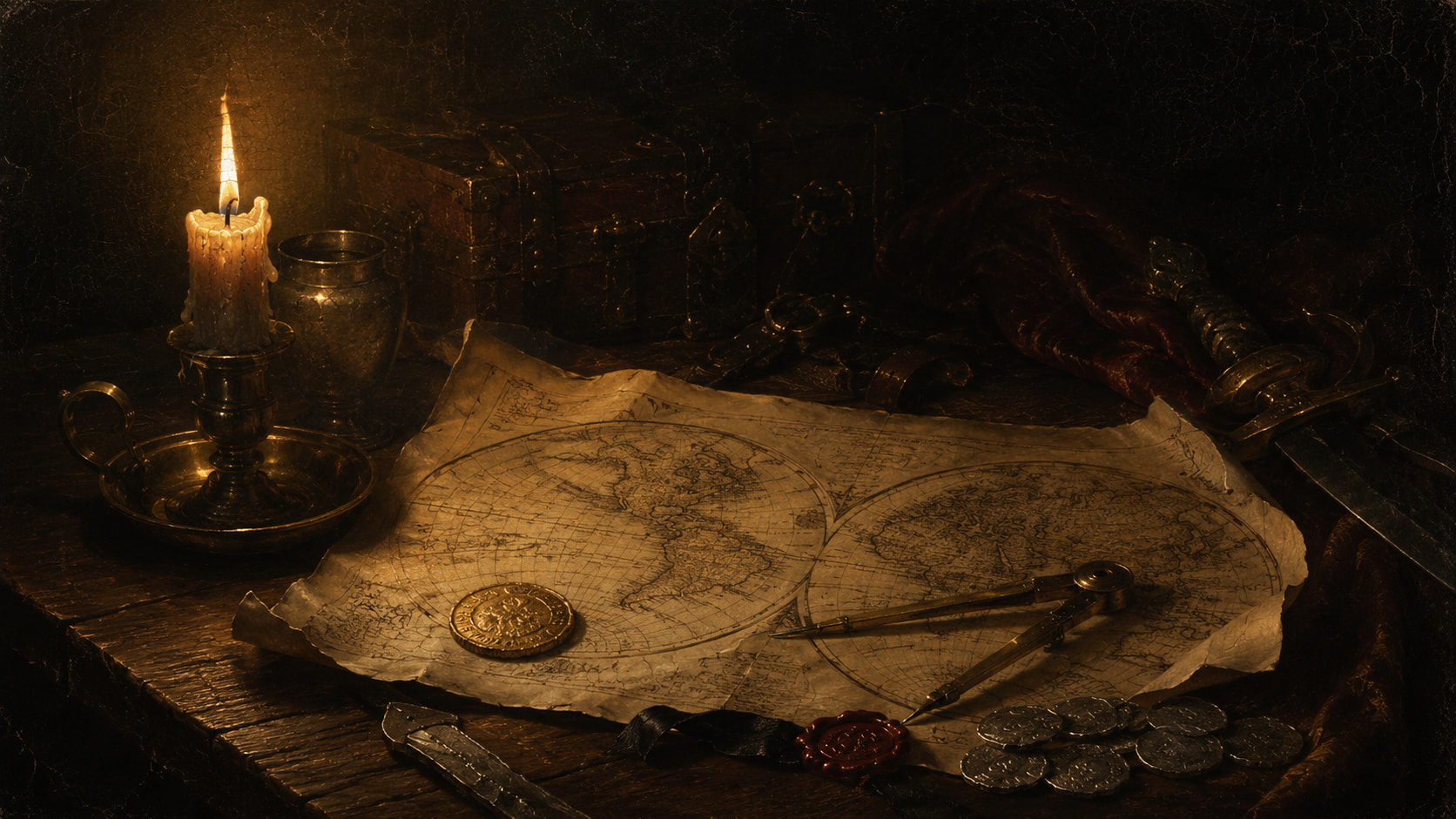
What a treasure legend is
Strip any of the fifty-six legends in this wing to its skeleton and the same five bones appear. A fortune — bullion, coin, jewels, relics — whose existence is documented or at least plausibly witnessed. A concealment event: a wreck, a burial, a walling-up, a retreat, done under pressure and therefore done imperfectly. The death of the knower — the mine’s discoverer, the paymaster, the captain — before recovery, taking the exactness of the location out of the world. The imperfect key: a map drawn from memory, a cipher without its keytext, a deathbed sentence half-heard, carved signs in the rocks. And the chain of seekers, because a treasure legend is not the treasure — it is the transmission: every teller adds a bearing, drops a landmark, moves the canyon one ridge west. The craft of this wing is running that chain backward — from the paperback to the newspaper to the court record to the manifest — until you stand on the earliest document that mentions the fortune at all. Everything after that point is lead; everything before it is gold.
The five great families
Every room in the wing belongs to one of five bloodlines, and each bloodline fails and pays in its own way. The lost mines, where a proven ore body loses its finder. The pirate and wreck gold, where the sea takes a documented cargo. The war chests, where a collapsing power buries or ships its treasury ahead of the enemy. The temple and royal hoards, where sanctity or dynasty seals wealth away for centuries. And the outlaw caches and ciphered fortunes, where the concealer wants recovery — by the right hands — and leaves a key. Learn the family and you know the failure mode: mines are lost to geography, wrecks to depth and jurisdiction, war gold to secrecy and executed witnesses, temple gold to taboo, and ciphers to the mortality of the one man holding the key. The rooms below are grouped accordingly; sail into any of them and you will find the full dossier — sources, maps, expedition history, and the room’s running argument.
The lost mines
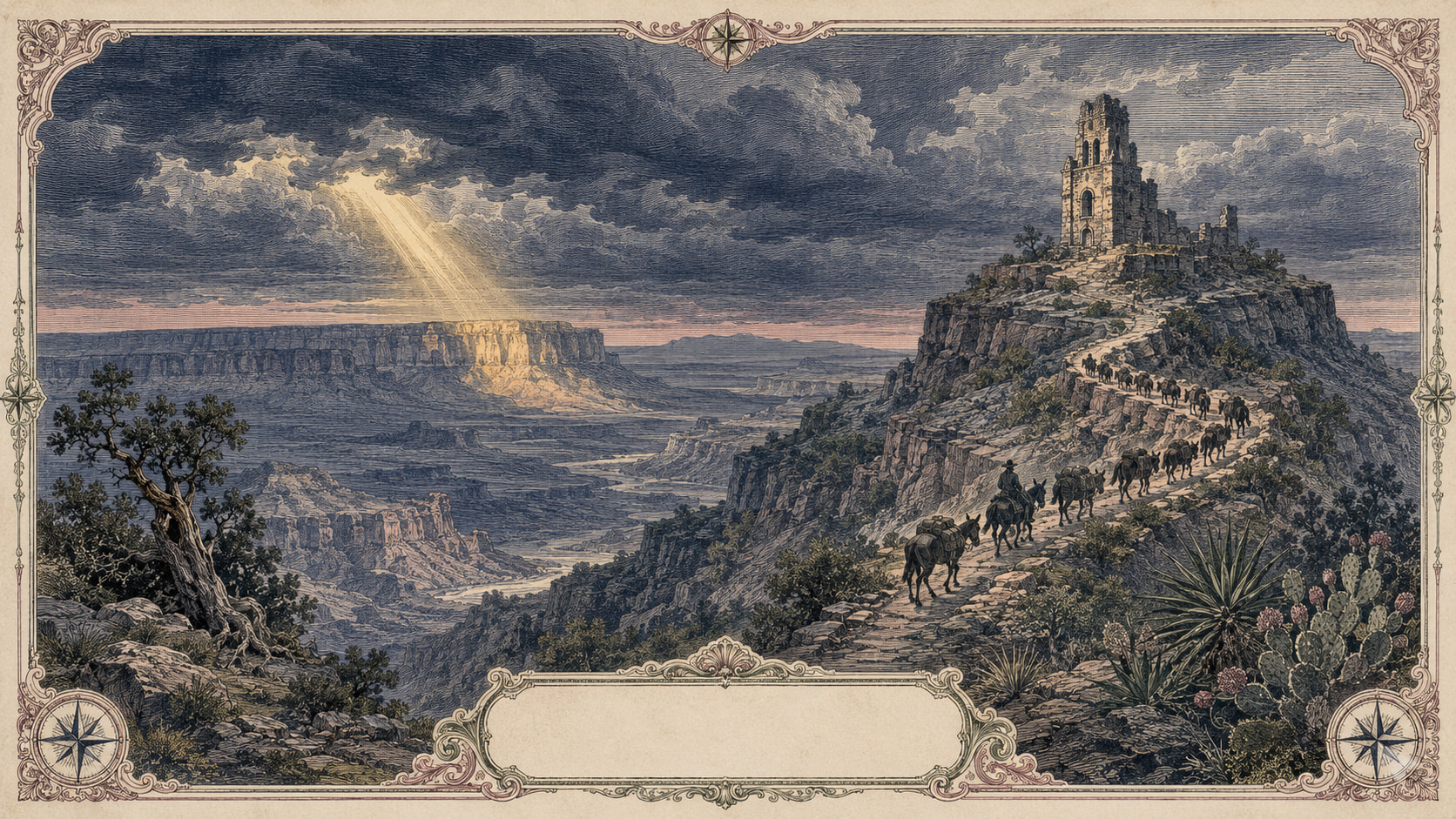
The American Southwest is the family’s heartland. The Lost Dutchman’s Mine is its king — Jacob Waltz’s deathbed cache of impossibly rich ore, October 1891, and the matchbox of gold under his bed that started a century of searching in the Superstition Mountains. The Lost Adams Diggings put a canyon floor paved with gold somewhere in the New Mexico borderlands and killed a fair share of the men who believed it. Death Valley’s lost mines — Breyfogle’s among them — added the cruelest terrain on the continent, and the Lost Ship of the Desert buried a pearl-laden Spanish galleon in the dunes of the Salton Sink for good measure. Deeper south, Tayopa and the Jesuit treasures preserve the tradition of the expelled order’s sealed bonanzas in the Sierra Madre. The family’s tell: the ore is usually real — assayed, sold, sworn to — and it is the way back that died.
The pirate’s ledger
The sea family begins with Captain Kidd’s treasure — the one pirate who verifiably buried gold (Gardiners Island, 1699, recovered and inventoried for his trial) and thereby fathered every buried-chest legend since. Blackbeard’s treasure rests on his own grinning testimony that only he and the devil knew where it lay. The Treasure of Lima — church gold worth a viceroyalty, hijacked aboard the Mary Dear in 1820 — made Cocos Island the most dug-over speck in the Pacific. The Flor de la Mar sank the plunder of Malacca in 1511 and is argued to be the richest wreck on earth. The 1715 Treasure Fleet strewed a Spanish plate convoy along a Florida shore that cashes coins to this day — and the Whydah Gally is the family’s proof-of-concept: Sam Bellamy’s flagship, lost 1717, found off Cape Cod in 1984, the first pirate wreck ever authenticated, bell and all.
The war chests
When powers die they bury. The Confederate treasury rode south from Richmond in 1865 and dissolved into a hundred Georgia farm-tales. The Nazi gold train haunts the tunnels of Lower Silesia; Lake Toplitz really did give up crates of forged pounds sterling from its depth-blackened water; Rommel’s gold waits, the story insists, in steel cases off Corsica. The Amber Room — the amber-panelled chamber the Nazis crated out of Tsarskoye Selo in 1941 — vanished at Königsberg and remains the single most hunted artwork on earth. Eastward, the gold of Kolchak bled from the Trans-Siberian in 1919; Yamashita’s gold allegedly went into Philippine tunnels ahead of 1945 — the legend a court once weighed in the Rogelio Roxas golden-buddha case — and the Awa Maru carried her contested billions to the bottom of the Taiwan Strait. Japan’s own earth holds the Tokugawa buried gold and the Toyotomi gold. War gold is the best-documented family — armies keep manifests — and the most dangerous to have known personally.
The temple hoards and royal gold
The oldest family. The legend of Solomon’s mines and the treasures of the Temple of Jerusalem — the Menorah last seen in Rome’s triumph of 71 CE — anchor it; the Copper Scroll is its working document, a Dead Sea inventory of sixty-four buried caches engraved on metal by men who meant it. The temple at Delphi banked the ancient world; Croesus and the Karun treasure show Lydian gold still surfacing — and still being fought over — in modern courts. The Padmanabhaswamy temple treasure is the family’s thunderclap: vaults opened in 2011 under India’s Supreme Court held gold and gems valued in the tens of billions, with the famous Vault B still sealed behind its serpent doors. Add the Peacock Throne, the diamonds of Golconda, the hoard of the Nibelungs sleeping in the Rhine, the Thracian gold that keeps erupting out of Bulgarian barrows, and the Visigothic treasure of Toledo — Alaric’s Rome-loot and the emerald Table of Solomon — and you have the shelf where treasure shades into scripture.
The ciphers, the relics, and the far kingdoms
The fifth family hides on purpose. The Beale treasure is pure key-lore: three cipher pages, one solved — by the Declaration of Independence — naming thirty-odd tons of gold and silver in a Bedford County excavation, two pages still dark since the 1885 pamphlet that started the war over whether any of it ever existed. The KGC rooms track the Knights of the Golden Circle’s alleged post-war depositories and the carved Spanish signs and symbols that overlap them; Jesse James rides through half those tales. Oak Island is the family’s cathedral — two centuries of engineering against the Money Pit’s flood tunnels. The relic wing runs the Holy Grail, the Cathar treasure of Montségur, Rennes-le-Château and the Knights Templar treasures. And the far kingdoms widen the map: Butuan, Srivijaya, the gold of Angkor, the Nizams of Hyderabad, Nana Sahib, the Heike treasure and the lost sword Kusanagi, Ubar of the Pillars, King Sebastian’s lost treasure, the Sacambaya Jesuit hoard, Montezuma’s treasure with the wider Aztec, Inca and Spanish treasures, the Icelandic sagas with their silver-keld barrows, and the Honjo Masamune, the greatest sword in Japan, signed out of a Tokyo police station in 1946 and never seen again. General debate and new candidates muster in Treasure Legends — General.
The ledger of the found
This wing does not run on faith; it runs on precedent. Schliemann read Homer as a waybill and pulled the gold of Troy out of Hisarlik in 1873. The Whydah went from tavern-tale to museum in 1984. Mel Fisher’s crews, after sixteen years and terrible cost, raised the Atocha’s forty-plus million dollar mother lode from the Florida Straits in 1985. Tommy Thompson’s sonar found the SS Central America and her three tons of Gold Rush treasure in 1988. The 1715 fleet still pays — a single family crew banked over four million dollars in coins off Vero Beach as recently as 2015. Colombia located the galleon San José, the richest wreck ever documented, in 2015. The Padmanabhaswamy vaults opened in 2011 onto wealth that embarrassed the estimates. Detectorists gave Britain the Hoxne hoard in 1992 and the Staffordshire hoard in 2009. And Forrest Fenn’s chest — hidden in the Rockies in 2010 on nothing but a poem — was found in June 2020, proving the oldest mechanism of all still works.
The ledger keeps its cautionary column too. In 2007 Odyssey Marine lifted seventeen tons of silver coin from a wreck it code-named the Black Swan — and then watched five years of courtrooms identify the ship as the Spanish frigate Nuestra Señora de las Mercedes, blown up by the British in 1804, and order every coin flown to Madrid. Half a billion dollars, salvaged flawlessly and owned for exactly as long as the paperwork took. The lesson the wing tattoos on every newcomer: the archive stage never ends — the same documents that find a treasure decide who keeps it. The wing keeps the full ledger, mapped where each hoard came out of the ground, in the Hoard Atlas — the other half of every tale told here.
The paper trail
The difference between a hunter and a dreamer is archives. The Archivo General de Indias in Seville holds the manifests, salvage reports, and survivor depositions of the entire Spanish plate-fleet system — the Atocha was found because Eugene Lyon read her paperwork right and moved the search fifty leagues. War gold answers to quartermaster records, courts-martial, and interrogation files; temple gold to chronicles and epigraphy; ciphers to the brutal disciplines of cryptanalysis, which is why the Beale fight is really a fight about the 1885 pamphlet’s word-frequencies. The trade has its poisons, and the wing catalogues them without blushing: the fake Kidd charts that surfaced around Hubert Palmer’s chest collection in the 1930s, the salted mines of every gold rush, the waybills that multiply after a legend gets famous. House rule: date every document, and ask who profits by its existence. A map that first appears three hundred years after the burial is not a map; it is a ticket being sold.
The anatomy of a hunt
Every serious pursuit in this wing runs the same four-stage course, and the forum is built so each stage has its own deck. The archive stage comes first and lasts longest: manifests, depositions, land patents, newspaper morgues, parish records — the craft taught and traded in Historical Research, where a single misread league or mistranscribed date has moved treasure hunts into the wrong county for a century. The terrain stage walks the story onto the ground: matching the chronicle’s river-bends and mission ruins to survey maps and lidar, reading the carved trail-signs catalogued in Treasure Markers & Signs and Spanish Signs & Symbols. The survey stage brings the instruments — magnetometry, ground-penetrating radar and resistivity from Geophysical Surveying, aerial and satellite work from Remote Sensing, and for the drowned families the side-scan and sub-bottom craft of Sunken Hoards. It was exactly this marriage — Lyon’s archive work plus Fisher’s magnetometers — that turned the Atocha from legend to ledger. And the recovery stage is where fortunes are commonly ruined rather than made: excavation discipline, documentation, and the conservation science of Cleaning, Restoration & Preservation, because a hoard mishandled at the lip of the hole loses half its value and all its story. The wing’s dossiers tell you where to look; the Golden Hoard’s workshops tell you how — the two decks are one ship.
The rule of the wing
Four habits keep the rooms honest. Run the chain backward — find the earliest attestation and read outward from it. Separate the site from the yarn: the geology, the ruins, the wreck-scatter are data even when the story wrapped around them is embroidery. Log the searches too — a legend’s expedition history is half its dossier, and knowing where forty parties already dug is worth more than a fresh rumor. And bank the recoveries: when a legend pays out anywhere on earth, it gets a Hoard Atlas entry, because every find recalibrates what the remaining stories are worth. Newcomers: pick one room, read its seed top to bottom, then bring documents, not certainty. The wing has room for both the believer and the auditor — what it has no room for is an empty citation.
The treasure-hunter’s charter
Why this wing leads the whole forum: because the legends are the industry’s exploration map. Every family above has already paid at least once — the mines (Kennedy-era rediscoveries of lost lodes), the wrecks (Atocha, Central America, the 1715 beaches), the war gold (Toplitz’s crates, the Bactrian gold that turned up intact in a Kabul vault in 2003), the temple hoards (Padmanabhaswamy), the ciphers (Fenn). The expected value of the unpaid remainder is the argument this wing exists to have, room by room, document by document. Somewhere in these fifty-six dossiers is the next Whydah — a story everyone has heard and no one has properly read. The charter of Legends of the Lost is simple: read it first.
Related wings
The Briny Deep · The Golden Hoard · Secret Societies · Historical Research · Cartographer’s Archive
Sources & further reading
- The Archivo General de Indias, Seville — plate-fleet manifests, salvage files, and survivor depositions; Eugene Lyon’s archival work behind the Atocha search
- The Kidd inventory of Gardiners Island (1699) and the trial record — the documented root of buried pirate gold
- The Beale Papers pamphlet (1885) and the century of cryptanalytic literature for and against it
- Barry Clifford’s Whydah excavation reports (1984– ); Mel Fisher’s Atocha recovery record (1985); the SS Central America court and salvage files (1988– )
- The Supreme Court–supervised inventories of the Padmanabhaswamy temple vaults (2011– )
- The Amber Room dossier — Tsarskoye Selo to Königsberg, 1941–45 — and the post-war search literature; the Lake Toplitz recovery operations (1959, 1963, 2000)
- The Rogelio Roxas v. Marcos judgment — the courtroom life of Yamashita’s gold
- The Hoxne (1992) and Staffordshire (2009) hoard reports — the modern detectorist vindications
- Forrest Fenn, The Thrill of the Chase (2010) and the 2020 recovery announcement
- The wing’s own Hoard Atlas — the living map of legends that paid
Weigh in
- Which family do you rate richest in unrecovered value today — the mines, the wrecks, the war chests, the temple vaults, or the ciphers?
- Name the legend in this wing you think is closest to paying out — and the single document that would crack it.
- Best vindication of the ledger: Whydah, Atocha, Padmanabhaswamy, or Fenn?
- And the auditor’s question: which famous legend here do you think never held a single coin?
Reply below, or sail straight into a room — fifty-six doors, every one with a dossier behind it. This is the main deck of the lost; the hunt musters here.