An Around the World field entry. This is the treasure heart of the New World — the land of El Dorado and the Inca gold, of the Spanish treasure fleets and the pirate Main, of jungle cities lost to the green and galleon graveyards lost to the sea. No region has launched more obsessive quests or yielded more sunken gold. This is Latin America and the Caribbean for the finder: where the dream of New World gold was born, and where so much of it still lies in the lake, the jungle, and the deep.
If treasure-hunting has a spiritual homeland, it is here — in Latin America and the Caribbean, the region that gave the world the very dream of New World gold. It was the rumor of unimaginable wealth that drew the conquistadors across the ocean, and the reality exceeded the rumor: the gold of the Aztecs and the Incas, the silver of the Andes, a flood of treasure so vast that it remade the global economy. The Spanish gathered that wealth and shipped it home in great fleets — and lost staggering quantities of it to storm, war, and piracy along the way, salting the Caribbean and the Spanish Main with the richest shipwreck-treasure in the world. And around it all grew the most powerful treasure legends ever told: El Dorado, the gilded king; the lost gold of the Incas; the buried hoards of the buccaneers; the jungle cities swallowed whole. This is an overview of the region where the treasure dream was born — the gold that was found, the gold that was lost, and the legends that drive the search still.
El Dorado
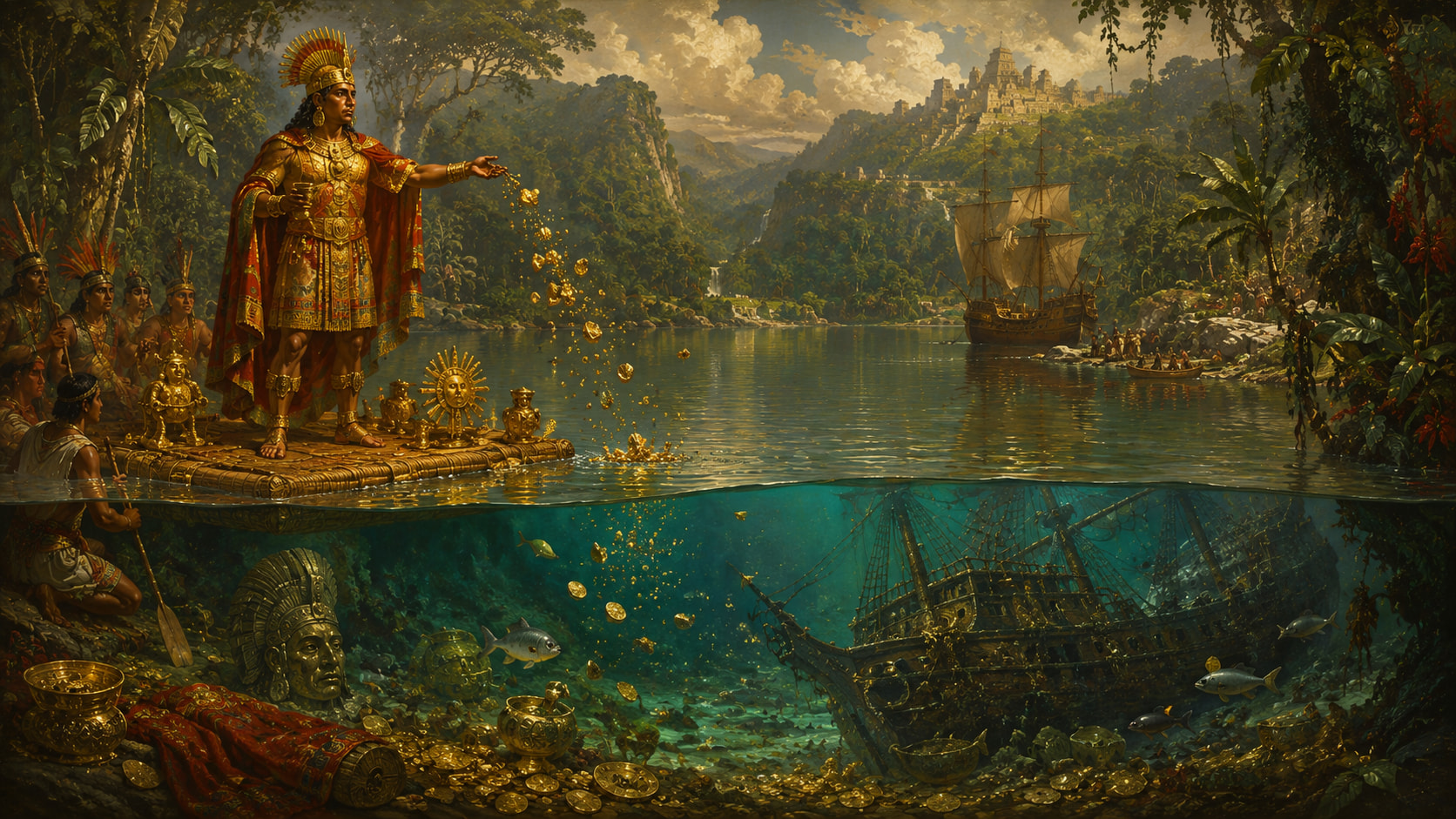
The greatest treasure legend in history began here: El Dorado. It started with a real ritual — a Muisca king of what is now Colombia, the legend holds, would cover himself in gold dust and cast offerings of gold and emeralds into the sacred waters of Lake Guatavita. From “the gilded one,” the tale swelled into the legend of a whole kingdom and city of gold somewhere in the unexplored interior of South America — and that legend drove the European conquest of a continent, sending expedition after expedition to their deaths in the search. El Dorado was never found, because in its grandest form it never existed — yet the real gold of the region was so abundant that the dream seemed always just over the next ridge. Lake Guatavita has been drained and probed for its offerings; the legend has never died. El Dorado is the supreme treasure-legend of all, the gilded dream that opened the New World.
The gold of the Incas
The Andes held the richest empire of all — and its fall produced one of history’s greatest lost-treasure stories. When the Spanish captured the Inca emperor Atahualpa, they demanded a ransom that filled a room with gold and twice with silver — and then killed him anyway. The legend holds that a vast further treasure, on its way to complete the ransom, was hidden by the Incas when they learned of his death — spirited into the mountains and never recovered. From this grew the enduring legends of lost Inca gold: the Treasure of the Llanganates, hidden in a misty Ecuadorian mountain range and sought by the cryptic guide of Valverde for centuries; and Paititi, the legendary lost Inca city of gold, said to lie hidden somewhere in the Amazon rainforest, still hunted by explorers today. The Inca and Spanish treasure of the Andes is among the greatest lost wealth on earth — a fallen empire’s gold, hidden in the mountains and the jungle, never found.
The treasure fleets
The Spanish gathered the wealth of the New World and shipped it home across the Atlantic in great convoys — and the sea took a fearful share. For three centuries, hurricanes, reefs, and enemy fleets sent treasure-laden galleons to the bottom, making the Caribbean and the waters off the Spanish Main the richest shipwreck-treasure region in the world. The most famous prize of all is the Nuestra Señora de Atocha, the Spanish galleon lost off the Florida Keys in 1622, whose immense cargo of gold, silver, and emeralds was discovered by the salvager Mel Fisher in 1985 after a sixteen-year search — one of the greatest treasure recoveries in history. The 1715 Treasure Fleet, wrecked off Florida, still gives up gold to this day. The galleon graveyards of the region are the proof that the treasure was real and that much of it is still down there, in the warm clear water, waiting.
The pirate Main
Where the treasure fleets sailed, the pirates followed — and the Caribbean became the legendary haunt of the buccaneers, salting the region with the richest pirate-treasure lore in the world. The great pirates worked these waters: Blackbeard, Captain Kidd, Henry Morgan, and a hundred others, raiding the Spanish gold and — the legends insist — burying their plunder on lonely cays and islands across the sea. And here lies one of history’s great real treasure-mysteries of a different kind: Port Royal, the wealthy pirate city of Jamaica, the “wickedest city on earth,” which was swallowed by the sea in a catastrophic earthquake in 1692 — a sunken city, with its wealth, lying beneath the harbor. The pirate Caribbean is the very image of buried treasure: the cay, the chest, the map, the sunken city — the romance that built the whole treasure-hunting dream.
The island hoards
Some of the region’s most famous legends are bound to its islands. Greatest is the Treasure of Lima, buried on Cocos Island — the immense wealth said to have been carried off from Lima during the wars of independence and buried on a remote Pacific island off Costa Rica, hunted by hundreds of expeditions and never found, the most sought-after island treasure on earth. Inland, in the mountains of Bolivia, lies the legend of the Sacambaya Jesuit treasure — a vast hoard said to have been hidden by the Jesuits before their expulsion, sought in one of the most famous and futile treasure-digs of the twentieth century. The island and Jesuit hoards add yet another layer to the region’s treasure inheritance — the lonely cay and the mountain vault, each guarding its fortune.
The hunt, and the law
Treasure-hunting across the region is dominated by the sea, and by an increasingly strict legal regime. The era of the freelance treasure-salvager — the Mel Fisher model — has given way to a world in which most nations and international conventions firmly protect underwater cultural heritage, asserting state ownership of shipwrecks and tightly regulating or forbidding private salvage. On land, the great archaeological civilizations — the Inca, the Maya, and their kin — are protected by strict antiquities laws, and the looting of sites is a serious crime. The romance of the region’s treasure is immense and its wrecks genuinely rich, but the modern reality is one of heritage protection: the serious enthusiast engages through history, licensed and ethical archaeology, and respect for the law and the cultures whose gold this was. The galleons are real — but they are, rightly, no longer a free-for-all.
The treasure-hunter’s New World
Why is Latin America and the Caribbean the spiritual home of treasure-hunting? Because this is where the dream began — where the rumor of gold drew the world across an ocean, and the reality proved richer than the rumor; where the greatest legends were born (El Dorado above all) and the greatest real treasures were both found and lost; where the galleon graveyards still hold the richest sunken gold on earth, and the jungle still hides cities lost to the green. To hunt treasure anywhere is to be an heir of this region — of the conquistador chasing El Dorado, the diver on the Atocha, the seeker on Cocos Island with a crumbling map. The gold of the Incas may still sleep in the Llanganates; Paititi may still wait in the Amazon; the galleons still litter the deep. The treasure heart of the New World has given up fortunes — and, by every sign, keeps far more still.
Related rooms
Treasure of Lima / Cocos Island · The Sacambaya Jesuit Treasure · Aztec, Inca, and Spanish Treasures · Mexico
Sources & further reading
- El Dorado: the Muisca ritual at Lake Guatavita and the legend that drove the conquest of South America
- The Inca gold: the ransom of Atahualpa, the Treasure of the Llanganates (Valverde’s guide), and the lost city of Paititi
- The treasure fleets: the Nuestra Señora de Atocha (recovered by Mel Fisher, 1985) and the 1715 Treasure Fleet
- The pirate Caribbean: Blackbeard, Captain Kidd, Henry Morgan, and the sunken city of Port Royal (1692)
- The island and Jesuit hoards: the Treasure of Lima on Cocos Island and the Sacambaya Jesuit treasure of Bolivia
- Modern law: the protection of underwater cultural heritage and the antiquities laws guarding Inca, Maya, and other sites
Weigh in
- El Dorado drove a continent’s conquest but never existed as a golden city — why do you think the dream had such power?
- The lost Inca gold — the Llanganates, Paititi — still draws expeditions. Do you think any of it will ever be found?
- The Atocha proved the galleon gold is real and recoverable. With salvage now tightly restricted, how should the wrecks be handled?
- Cocos Island has defeated hundreds of expeditions — is the Treasure of Lima really there?
Reply below. Bring your New World treasure lore, your El Dorado and Inca-gold theories, and your galleon and pirate finds — this room is built to weigh them all.