An Around the World field entry. For two thousand years the gold of the world flowed into India and did not flow out — into its temples, its treasuries, and its earth — until the subcontinent became, in the phrase of the ancients, the sink of the world’s gold. No land on earth has accumulated, hidden, and lost more treasure: the richest temple hoard ever discovered lies in Kerala with one vault still sealed; the only diamond mines of the old world gave up the Koh-i-Noor and the Hope; Mughal emperors sat on a throne of solid gold and gems; and the richest man in the world kept his diamonds in a paperweight. This is India for the finder — the deepest treasure tradition on the planet.
If there is one country that stands at the summit of the world’s treasure history, it is India. For more than two millennia, the subcontinent was the great destination of global wealth: Roman gold poured east to pay for Indian spices, pearls, and gems until Roman writers complained that India was draining the empire of its bullion; and century after century, that gold flowed in and stayed, accumulating in temples and treasuries on a scale found nowhere else on earth. India became, quite literally, the place where the world’s gold went to rest. And because its history is also one of repeated invasion, conquest, and upheaval, that immense wealth was buried, hidden, looted, and lost again and again. The result is a treasure inheritance of unmatched depth and richness — the richest temple hoard ever found, the source of the world’s most famous diamonds, the fabled thrones of emperors, and the hidden fortunes of kings — much of which is documented, much legendary, and a remarkable amount still unaccounted for. This is a finder’s overview of the deepest treasure-ground on the planet.
The treasure of the temples
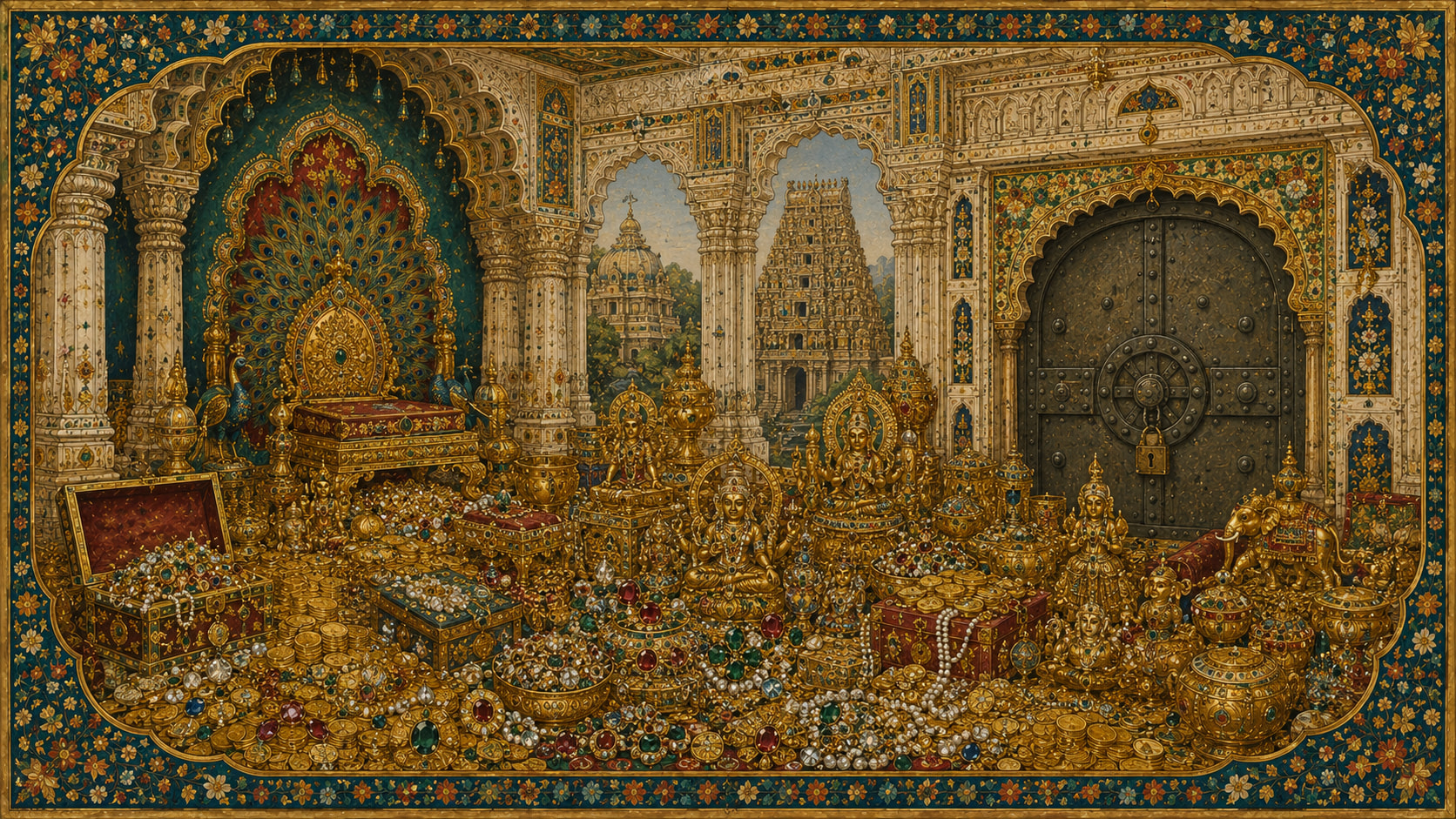
Nowhere is India’s wealth more concentrated than in its temples. For centuries, kings, merchants, and pilgrims poured offerings of gold, silver, and jewels into the great temples, which became treasuries of almost unimaginable richness — and the proof emerged in our own time. In 2011, the opening of sealed vaults beneath the Padmanabhaswamy Temple in Kerala revealed gold, jewels, and precious objects so vast that it became recognized as the richest treasure hoard ever discovered at a single site — and one of its vaults, the legendary Vault B, has remained sealed, the subject of awe and dispute, its contents unknown to this day. Padmanabhaswamy is only the most spectacular example of a tradition that fills Indian temples with accumulated wealth, and that, across history, made temples the prime target of invaders and the prime hiding-place of treasure. (Padmanabhaswamy has its own room in the Legends of the Lost.) The temple-hoard is the beating heart of India’s treasure story.
The diamonds of Golconda
For nearly two thousand years, until the eighteenth century, India was effectively the only source of diamonds the world knew — and they came above all from the fabled mines around Golconda in the Deccan. From this single region came the most legendary diamonds in history: the Koh-i-Noor, the Hope Diamond, the Regent, the Orlov, the Great Mogul — stones that passed through the hands of emperors and were fought over across continents. The very name “Golconda” became a synonym for a source of vast wealth. The diamonds of India crowned the treasuries of Mughal emperors and European monarchs alike, and several of the greatest — lost, recut, or vanished — are themselves among the world’s great missing treasures. (The Diamonds of Golconda have their own room in the Legends of the Lost.) No other land has given the world so many of its legendary stones.
The magnificence of the Mughals
At its height, the Mughal Empire presided over a court whose wealth astonished every visitor. The emperors accumulated treasure on a colossal scale, and nothing symbolized it more than the Peacock Throne — a seat of solid gold, encrusted with the empire’s greatest gems, including for a time the Koh-i-Noor itself, commissioned by Shah Jahan, the builder of the Taj Mahal. The throne was the very emblem of imperial Indian splendor — until 1739, when the Persian conqueror Nadir Shah sacked Delhi and carried off the Peacock Throne and a staggering hoard of Mughal treasure to Persia, after which the original throne was broken up and lost. (The Lost Peacock Throne has its own room in the Legends of the Lost.) The Mughal treasure, scattered by conquest, seeded lost-treasure legends across India, Persia, and Central Asia.
The richest man in the world
Into the modern era, India’s wealth remained legendary — above all in the person of the Nizam of Hyderabad, who in the early twentieth century was reputed to be the richest man in the world. The Nizams’ treasure included the famous Jacob Diamond, said to have been used as a paperweight, and a jewel-collection of fabulous value — and around the dynasty swirled enduring legends of a vast hidden hoard, treasure secreted away and never fully accounted for. (The Gold of the Nizams of Hyderabad has its own room in the Legends of the Lost.) The Nizams stand as the last great embodiment of the old Indian tradition of concentrated, dynastic, half-hidden wealth — a richness so great it passed into legend even in the age of newspapers and banks.
The gold of the rebellion
India’s treasure story is also a story of upheaval, and no upheaval buried more than the great Rebellion of 1857. As the uprising against the East India Company convulsed northern India, fortunes were hidden, carried off, and lost in the chaos of war — and the most famous case is that of Nana Sahib, a leader of the rebellion, whose treasure (the legendary “eight elephants of gold,” in one telling) is said to have vanished with him when he fled toward Nepal and disappeared from history. The lost treasure of Nana Sahib has been hunted ever since. (It, too, has its own room in the Legends of the Lost.) The rebellion is only the most dramatic instance of a recurring Indian pattern: in times of war and conquest, the wealthy buried what they could — and the dead and the defeated took the secret of its location with them.
The plunder of empire
The flow of India’s wealth was not only inward. Under the East India Company and then the British Raj, an immense quantity of Indian treasure flowed out — so much, and so notoriously, that the very word “loot” entered the English language from the Hindi lūt. The Company’s conquests and the Raj that followed carried off tribute, plunder, and treasure on a vast scale, and some of India’s most famous jewels ended their journeys in Britain — the Koh-i-Noor set into the Crown Jewels, where it remains a live object of dispute and demands for return to this day. The colonial chapter added a bitter dimension to India’s treasure history: a great draining-away of accumulated wealth, the reverse of the ancient inflow, and a legacy of contested ownership that still shapes how the world’s museums and crowns regard the treasures of the subcontinent.
Hidden from the invaders
Underlying all of this is a deep and ancient habit born of India’s turbulent history: the hiding of wealth from invaders. Time and again, from the devastating raids of Mahmud of Ghazni — whose repeated sackings of the fabulously rich temple of Somnath became legendary — through centuries of conquest and war, the temples and rulers of India concealed their treasure against the coming storm: walling it into sealed vaults, burying it beneath shrines, sinking it in temple tanks, hiding it in the earth. Much was recovered when the danger passed; much was not, the keepers slain or scattered and the secret lost. This is why the Indian ground and the Indian temple are so rich with hidden treasure — the subcontinent’s wealth was buried not once but countless times, across two thousand years of invasion, and not all of it was ever dug back up.
The hunt, and the law
India today guards its treasure heritage closely. The colonial-era Treasure Trove Act and a strict modern framework of antiquities law govern finds, and the great temple hoards — Padmanabhaswamy above all — are the subject of intense legal, religious, and governmental attention rather than open treasure-hunting. Casual metal-detecting of the Western kind is heavily restricted, and the export of antiquities is strictly forbidden. Yet the folk tradition of buried treasure runs deep in Indian life — in village lore, in stories of gupt dhan (hidden wealth), and unfortunately in the persistent scams and rituals that prey on the belief that treasure lies beneath old houses and temples. India’s relationship to its buried wealth is thus unlike the West’s: less a hobby than a matter of heritage, faith, and law, surrounding hoards whose scale dwarfs almost anything found elsewhere.
What the vaults still hold
Put it together, and India’s treasure inventory is staggering — and far from emptied. The sealed Vault B at Padmanabhaswamy may hold wealth beyond even what has already been counted. The fabled hidden hoard of the Nizams has never been fully accounted for. The countless temple treasuries of the subcontinent hold accumulated wealth still being catalogued. The buried caches hidden from a thousand years of invaders lie scattered beneath shrines, fields, and old foundations across the land. And the lost imperial treasures — the broken Peacock Throne, the vanished diamonds, the gold of the rebellion — echo through the lost-treasure legends of half of Asia. Few of these are open to the finder’s spade; most are matters of temple, state, and law. But the underlying truth is beyond dispute: more treasure has accumulated in India, and more of it remains, than almost anywhere on earth.
The treasure-hunter’s India
Why does India crown the world’s treasure-grounds? Because it is where the wealth of the world went and stayed — absorbed over two thousand years into the deepest reservoir of gold and gems the planet has known, then hidden and lost through an equally long history of invasion and upheaval. It offers the richest temple hoard ever found, the source of the world’s legendary diamonds, the thrones of emperors, and the fortunes of the richest men of their ages — a density and antiquity of treasure that no other land can match. For the finder, India is less a field to detect than a civilization to contemplate: the supreme example of how wealth concentrates, hides, and endures. The world’s gold flowed into India and largely never left — and a great deal of it, sealed in vaults and buried in the sacred earth, is there still, the deepest hoard of the deepest treasure-tradition on earth.
Related rooms
Padmanabhaswamy Temple Treasure · The Diamonds of Golconda · The Lost Peacock Throne · Gold of the Nizams of Hyderabad · Nana Sahib’s Treasure · Asia & Pacific Rim
Sources & further reading
- India as the historic destination of global bullion — the ancient Roman complaint of gold draining east, and the temple-treasury tradition
- The Padmanabhaswamy Temple treasure (vaults opened from 2011; the still-sealed Vault B) — the richest hoard ever found at a single site
- The diamond mines of Golconda — the old world’s diamond source, and the Koh-i-Noor, Hope, Regent, Orlov, and Great Mogul diamonds
- The Mughal treasury and the Peacock Throne; the sack of Delhi by Nadir Shah (1739)
- The Nizams of Hyderabad — the “richest man in the world,” the Jacob Diamond, and the legend of the hidden hoard
- The Rebellion of 1857 and the lost treasure of Nana Sahib
- The East India Company and the Raj: the etymology of “loot,” and the contested Koh-i-Noor in the British Crown Jewels
- Mahmud of Ghazni and the sackings of the temple of Somnath; the Indian tradition of hiding wealth from invaders
- The Indian Treasure Trove Act and modern antiquities law; the folk tradition of gupt dhan (hidden wealth)
- (For the great Indian legends in depth, see the dedicated rooms in the Legends of the Lost)
Weigh in
- Vault B at Padmanabhaswamy remains sealed — should it ever be opened, and what do you believe it holds?
- Of India’s legendary treasures — temple hoards, Golconda diamonds, the Peacock Throne, the Nizam’s hidden gold — which fascinates you most?
- The Koh-i-Noor and the question of return: where do you stand?
- If you know Indian or South Asian treasure lore — gupt dhan stories, temple legends, family tales — share it here.
Reply below. Bring your knowledge of the subcontinent’s treasures, your theories on the sealed vaults, and your South Asian treasure lore — this room is built to weigh them all.